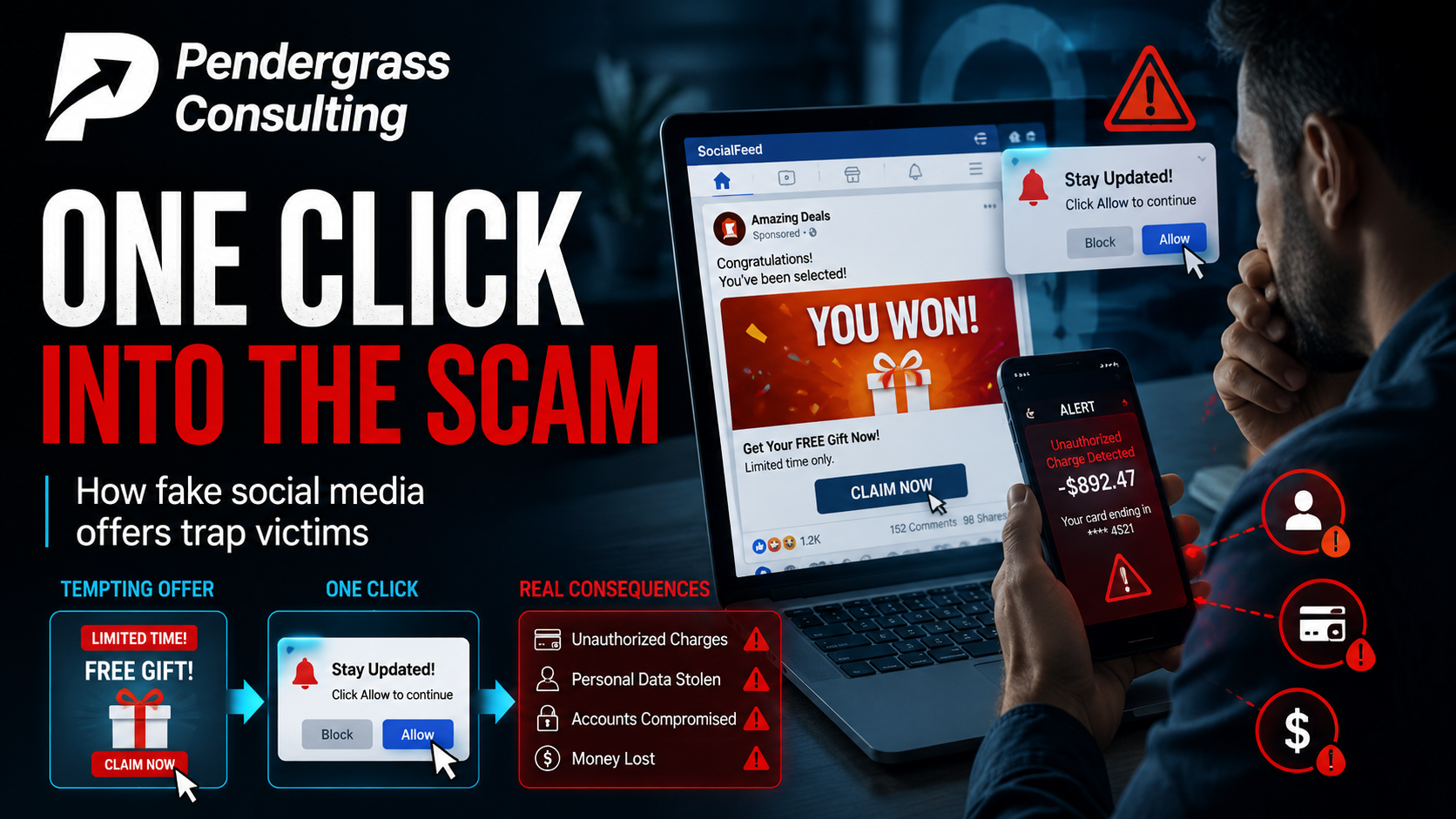
Here is a scam that should make every business owner think twice about that too-good-to-be-true offer in their social media feed. Security researchers recently pulled back the curtain on a sprawling fraud operation that ran on something deceptively simple: a fake offer on Facebook. A free gift. A special deal. A prize you have supposedly won. One tap, and the victim is pulled into a carefully built funnel designed to drain money from them in ways they will not see coming. There is no virus involved. No file to download. No software flaw to exploit. Just a tempting offer and a single, fateful click.
What makes this worth your attention is not the specific scam — those come and go — but how it works on people. It is a masterclass in manipulating ordinary human trust, and the exact same psychology is aimed at you, your employees, and your customers every single day. Understanding how this funnel works is the best inoculation against the next one, because while the offer will change, the trick never does.
The con that needs no malware
We tend to imagine hacking as a technical act — code, viruses, someone breaking through a digital wall. This operation is a reminder that the most effective attacks often involve no “hacking” at all. They simply manipulate a person into walking through the door willingly. The whole scheme runs on trust and human nature, not technical wizardry, which is exactly why your antivirus and your spam filter never get a chance to help. There is nothing technically malicious for them to catch. The only thing standing between the victim and the trap is their own judgment in the moment.
The scheme begins by borrowing trust it has not earned. The scammers set up fake accounts impersonating well-known, trusted names — a recognizable company, a public figure, a familiar brand — so the offer arrives wearing a costume of legitimacy. Then, instead of sending victims straight to an obviously sketchy website, they route them first through well-known, reputable online services, using those trusted middle steps as cover so the whole journey feels normal and safe. By the time the victim reaches the actual trap, they have been gently walked past every instinct that might have warned them, each step looking just legitimate enough to justify the next.
The trap that springs after the click
Once someone takes the bait, the funnel goes to work, and it is built to extract value in whatever way it can. Some victims are steered toward handing over personal or login information on a convincing fake page. Some are nudged into signing up for expensive recurring charges they never understood they were agreeing to. Some are pushed toward “investment opportunities” that are simply theft with extra steps. And one of the most insidious moves is a screen that asks the victim to click “Allow” to continue — presented as a harmless verification step. In reality, clicking that button hands the scammers a permanent open line to flood the person’s device with a stream of further scams, long after they have left the original page.
That “Allow” trick is worth dwelling on, because it is so ordinary and so easy to fall for. We are all conditioned to click whatever button makes the pop-up go away so we can get on with what we were doing. The scammers know this, and they dress up a genuinely consequential permission as a meaningless formality. It is the same instinct — click to continue, click to dismiss, click to get past the obstacle — that attackers exploit over and over, and it is exactly the instinct that has to be retrained.
Why this lands squarely on your business
You might think a fake-offer scam is a personal problem, not a business one. But your business lives on the same platforms where these scams run, and your employees carry the same instincts to work. The person who runs your social media sees fake offers and impersonator accounts all day. The employee checking a personal Facebook account on a work device is one tempting click away from inviting something onto a machine that touches your business. And the trust-borrowing technique at the heart of this scam — impersonating a name you recognize, routing you through familiar-looking steps — is precisely how the attacks aimed directly at your business work too. The fake offer becomes a fake invoice from a vendor you use, or a fake login page for a service you rely on. Same psychology, higher stakes.
The uncomfortable truth this scam lays bare is that no piece of software can protect a person from their own click. When the attack is built entirely out of trust and human nature, the only real defense is a person who has been taught to recognize the shape of the manipulation — who feels the pull of an offer that is a little too good, or a request that is a little too urgent, and treats that feeling itself as the warning sign.
Train the instinct, not just the rule
You cannot hand your team a list of every scam to avoid, because the specific offers change every week. What works is teaching the underlying instinct: a healthy pause before clicking a surprising offer, a reflex to verify who is really behind a too-good deal, an understanding that “click Allow to continue” is a decision and not a formality, and the confidence to treat anything that creates urgency or excitement as a reason to slow down rather than speed up. That instinct, spread across the people who run your business and touch your accounts, is worth more than any single piece of security software, because it works against the next scam as well as this one.
That is the work we do. We build focused, plain-language training around the real manipulations your team will actually encounter — the fake offers, the impersonated names, the urgent requests, the harmless-looking buttons that are anything but — so the people in your business become the defense that no software can replace. The scam in the headlines needed no malware and no technical skill. It only needed one person to trust the wrong thing for one second. The question worth asking is whether your team would recognize the trap, or click straight into it.
Sources: The Hacker News; Group-IB research; Cyber Security News, June 2026.