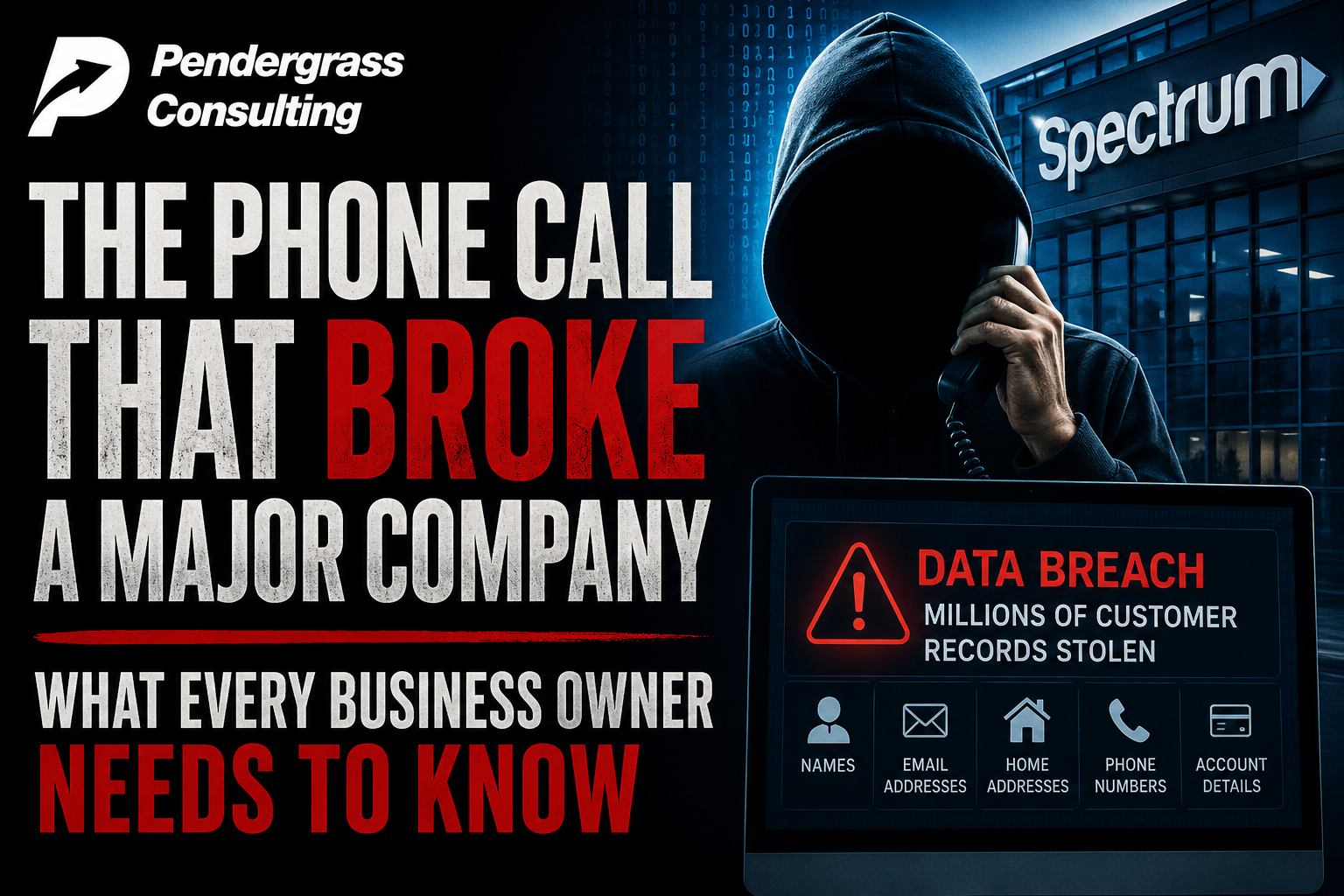
This week, Charter Communications — the company behind Spectrum, one of the largest internet and cable providers in the country — confirmed a data breach that exposed the personal information of millions of its customers. The stolen records include names, email addresses, home addresses, phone numbers, and account details, now circulating publicly after the company declined to pay the criminals who took them. It is a serious breach by any measure. But the detail every business owner needs to sit with is not the size of it. It is how it started.
There was no malware. There was no clever virus. There was no booby-trapped email attachment, no malicious link, no software flaw, no zero-day exploit. None of the things people picture when they imagine a “hack” happened here. The attackers got into one of the largest telecom companies in America the same way a con artist gets into anything: they made a phone call. One call, to one employee, and the door swung open. If you have ever told yourself your business is too careful, too small, or too well-defended for something like this, that single fact should stop you cold — because there is no firewall, no antivirus, and no software on earth that blocks a convincing phone call.
What actually happened
The technique is called voice phishing, or “vishing” for short, and it is exactly what it sounds like: phishing done over the phone instead of through email. According to the attackers, the chain of events was almost insultingly simple. Someone called a Charter employee and pretended to be someone the employee had every reason to trust — internal IT support, the kind of call that happens in a big company all the time. Through that conversation, the caller talked the employee into handing over the keys: the login credentials for the company account that controls access to internal systems.
That was it. That was the whole break-in. With valid credentials in hand — credentials that were freely given, not stolen by force — the attackers walked in through the front door looking exactly like a legitimate employee, because as far as the systems could tell, they were one. From there they reached the company’s customer database and quietly exported millions of records before anyone realized an outsider was inside. No alarm tripped, because nothing about the access looked wrong. The locks were never picked. Someone was simply talked into opening the door.
It is worth pausing on how unglamorous that is. We spend enormous energy imagining cyberattacks as a battle of technology — hackers in hoodies, walls of code, sophisticated tools probing for weaknesses. And that world exists. But the most effective attack against one of the country’s biggest companies this year did not need any of it. It needed a phone, a believable story, and one human being having a normal, busy day.
Why this is the attack that should scare you most
Here is the uncomfortable truth this breach lays bare: every dollar a business spends on security technology protects the walls, and this attack walked right past the walls by knocking on the front door and being let in. Firewalls inspect network traffic — a phone call is not network traffic. Antivirus scans files and programs — a conversation is not a file. Spam filters catch suspicious emails — there was no email. Every automated defense most businesses rely on is built to catch a technical attack, and this was not a technical attack. It was a human one. It targeted the one part of your business that no software protects: a person’s judgment in the moment they are asked to trust someone.
And that is precisely why it is so dangerous for a small business. You might assume this is a big-company problem — that criminals only bother with elaborate phone schemes against giants like Charter. The opposite is true. A small business is an easier target for this, not a harder one. Your team is smaller, often busier, and far less likely to have ever been warned that a friendly, confident phone call could be an attack. The caller does not need to fool everyone. They just need to reach one person — the new hire, the part-timer, the helpful employee who does not want to seem difficult — and have one convincing conversation. If a vishing call can talk its way into a company with an entire security department, consider honestly how it would go if someone called your front desk this afternoon claiming to be from your software vendor, your bank, or your own IT support, and asked for a code or a login “to fix an urgent problem.”
How these calls actually work on people
The reason vishing succeeds has nothing to do with the victim being foolish, and everything to do with how skilled the attackers are at manipulating normal human instincts. These are not bumbling scammers. They are practiced social engineers who understand exactly which psychological buttons to press. They create a sense of urgency, so the employee feels there is no time to stop and verify. They borrow authority, posing as IT or management, because most people are wired to cooperate with someone who sounds like they are in charge. They offer to be helpful — “I’m just here to fix the issue for you” — which flips the employee’s guard down and their gratitude up. And they count on the simple, human reluctance to be rude, to push back, to say “let me call you back and confirm” to someone who sounds friendly and legitimate.
Against a well-run version of that script, “be more careful” is useless advice, because the whole attack is engineered so that careful, conscientious people fail it. The employee who got fooled at Charter was very likely a good, capable worker who was simply doing what felt like their job: helping someone who sounded like a colleague with an urgent problem. That is the trap. The instinct that makes someone a good employee — being helpful, responsive, cooperative — is the exact instinct the attacker turns into a weapon. You cannot fix that with a policy memo nobody reads. You fix it by actually preparing people for the specific moment it happens.
The one defense that actually works against this
If technology cannot stop a phone call, what can? The answer is the only thing that was ever going to work against a human attack: prepared humans. A team that has been genuinely trained does not rely on catching a technical clue, because there isn’t one. Instead, they carry a different instinct entirely — the reflex to recognize the shape of the situation. To feel the pressure of an urgent, unexpected request for access or information and have that pressure itself become the warning sign. To know, in their bones, that the right move when a caller asks for a code, a password, or access is never to comply in the moment, but to stop, hang up, and call back through a known, trusted number — and to understand that no legitimate request will ever suffer from that pause.
That instinct is not something people are born with, and it is not something a once-a-year compliance video instills. It comes from real, focused training built around the actual ways an attacker would target your specific business — the vendors you use, the way your team communicates, the requests that would seem normal coming through your door. The goal is not to make your employees paranoid or to turn them into security experts. It is to give every person who could receive that phone call the confidence to pause and verify, and the explicit permission to be a little “rude” to a stranger on the phone when something feels off. That confidence, spread across your team, is what turns your people from your softest target into your strongest defense.
The Charter breach is a multimillion-record reminder that the most expensive attacks in the world still come down to a single human conversation. The companies that get hurt are the ones that poured everything into technology and left their people untrained for the one kind of attack that technology cannot stop. Your business does not have to be one of them. If someone called one of your employees today with a confident voice and an urgent request, would they know what to do? That is the question worth answering now — before someone else asks it for you.
Sources: BleepingComputer; Cybernews; Fox News; and additional reporting on the Charter Communications (Spectrum) breach, June 2026.