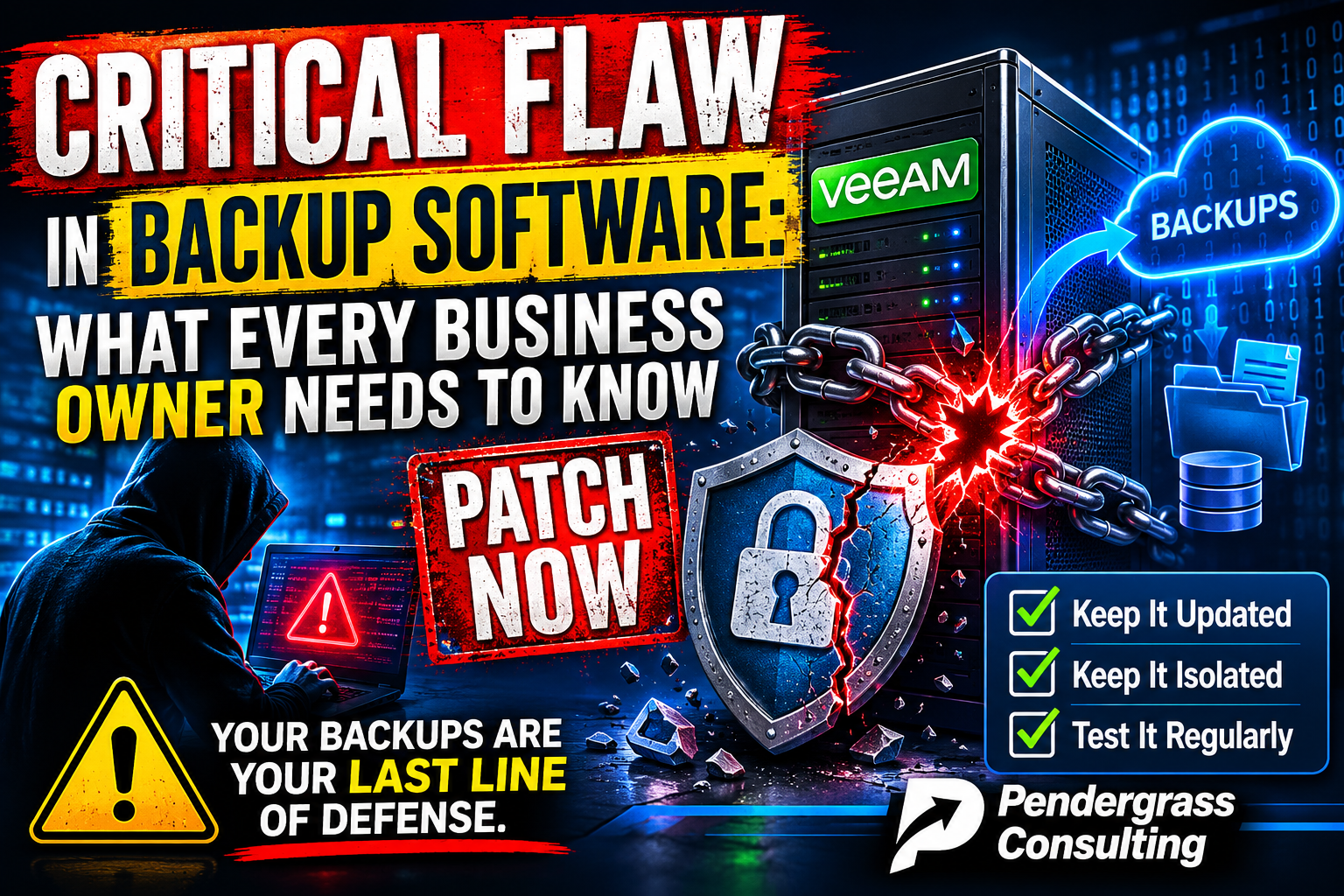
This week, the company behind one of the most widely used business backup products in the world — Veeam — announced a serious, critical flaw in its Backup & Replication software and urged customers to patch it immediately. In plain terms, the flaw could let an ordinary user on a company network take control of the very server that holds the business’s backups. It was given one of the highest severity ratings in the industry, and while there are no confirmed attacks yet, history says that window does not stay quiet for long. For most small business owners, this will read like distant, technical news about software they have never heard of. It is exactly the opposite. It goes to the heart of the one thing standing between your business and total disaster.
Your backup is your last line of defense. It is the thing that saves you when everything else has failed — when ransomware locks your files, when a server dies, when a flood or a fire or a simple human mistake wipes out your data. And this week’s news is a stark reminder of an uncomfortable truth that catches small businesses off guard again and again: a backup is not something you set up once and forget. It is a living system that has to be watched, maintained, and protected — because attackers know it is your lifeline, and it is the very first thing they go after.
Why attackers go after the backups first
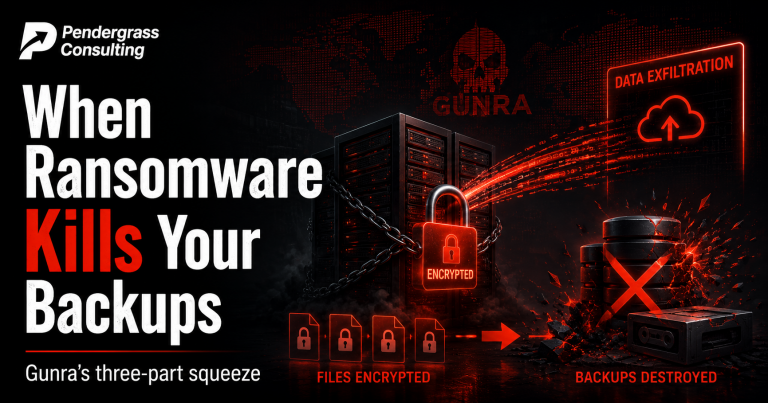
To understand why this matters so much, you have to understand how a modern ransomware attack actually works. The criminals’ goal is to put you in a position where paying them is your only option. And the single biggest thing standing in their way is a good backup. If your files get locked but you have clean, recent backups safely out of reach, you can simply restore everything and tell the attackers to take a hike. Your backup turns a catastrophe into an inconvenience.
The attackers know this. So the modern playbook is not to lock your files first — it is to find and destroy your backups first, and only then spring the trap. They go hunting for your backup system specifically, because if they can corrupt or delete it before you notice, they have taken away your escape route. When the ransom demand finally appears, you have nothing to restore from, and paying becomes the only path back to your own data. That is why a flaw in backup software is so much more dangerous than it sounds. It is not just another vulnerability. It is a crack in the one wall you were counting on to save you, and it is the exact wall the attacker was already trying hardest to knock down.
“I have backups” is not the same as “I’m protected”
Here is the assumption that sinks small businesses: the belief that having a backup and being protected are the same thing. They are not, and the gap between them is where disasters live. A backup is only as good as three things most owners never think to check, and that this week’s news throws into sharp relief.
First, is the backup system itself kept current and secure? As this week proved, the backup software is a piece of software like any other — it has flaws, those flaws get discovered, and fixes have to be applied promptly, or the backup becomes a doorway instead of a safeguard. A backup system that nobody is maintaining is quietly aging into a liability. Second, is the backup actually separated from the rest of your systems, so that an attacker who gets into your network cannot simply reach over and delete it too? A backup sitting wide open on the same network it is meant to protect is the first thing to fall. And third — the one that surprises people most — has anyone ever actually tested that the backup works? Countless businesses have discovered, at the worst possible moment, that the backups they were counting on for years were silently failing, incomplete, or impossible to restore. A backup you have never tested is not a safety net. It is a guess.
Almost no small business has clear answers to those three questions, and that is not a criticism — it is simply not the owner’s job to know. But it is the difference between a backup that saves you and a backup that gives you a false sense of security right up until the day you desperately need it and discover it is not there.
The false comfort of “it’s handled”
Most small businesses fall into one of two camps, and both are exposed. In the first, backups were set up once — maybe years ago, maybe by someone who is no longer around — and have been quietly running, or quietly not running, ever since. Nobody is checking. Nobody would know if they stopped. The owner believes it is handled, and that belief is the entire safety plan. In the second camp, there is no real backup at all beyond a copy of some files on a drive in a desk drawer or an account someone set up and forgot, which would be of little help against a serious attack or a real disaster.
What this week’s news should do is turn that vague comfort into a concrete question. Even the businesses doing it “right,” with professional-grade backup software, just learned that the software itself needs active attention to stay safe. The set-it-and-forget-it backup is a myth. Real protection is not a product you buy once. It is an ongoing responsibility — making sure the system stays patched and secure, that the backups are isolated where attackers cannot reach them, that they are tested regularly so you know beyond doubt they will work, and that someone is actually watching the whole thing. That responsibility is precisely what falls through the cracks in a busy small business, and precisely where a real partner earns their keep.
Find out if your last line of defense would actually hold
If this week’s headline did anything, let it be this: it should make you ask, honestly, whether your business could fully recover if your data disappeared tomorrow. Not whether you have “a backup somewhere” — whether you have a backup that is current, secure, isolated, tested, and watched. If you cannot say yes to all of those with confidence, you have a gap exactly where you can least afford one.
That is something we can help you find out. We offer a straightforward environment review for small businesses that looks honestly at your backup and recovery situation — whether your last line of defense would actually hold when everything else has failed, where the gaps are, and what it would take to close them before a disaster, not after. We also provide private cloud backup with up to hourly snapshots, built and managed so it is isolated, tested, and watched the way a true safety net has to be. No jargon, no scare tactics, no obligation — just a clear answer to the most important question a business owner can ask: if the worst happened tomorrow, would I get my business back? After a week like this one, that is worth knowing for certain.
Sources: Veeam security advisory (KB4869); The Hacker News; BleepingComputer, June 2026.