
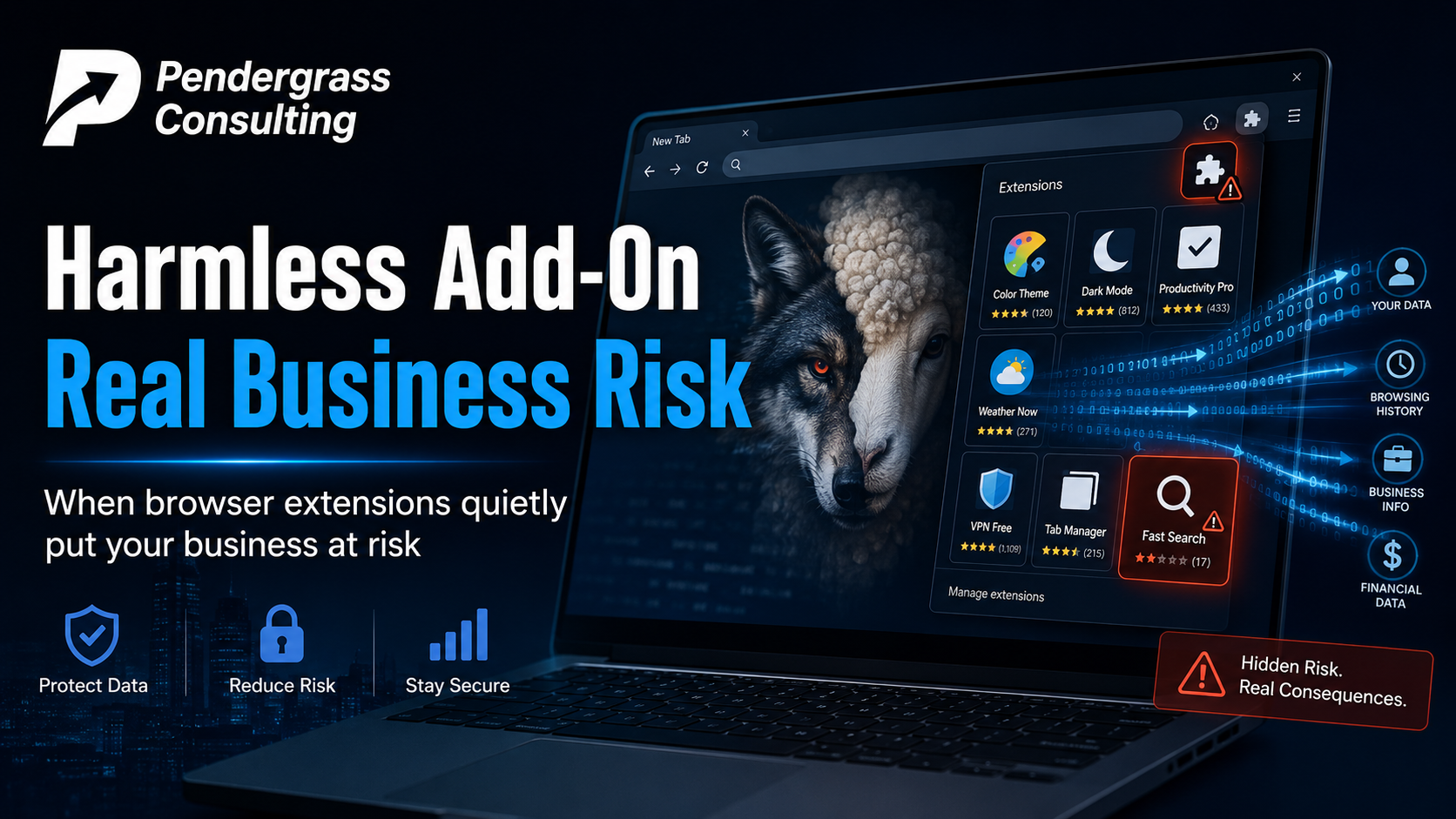
Here is a small, unsettling story that says a lot about how risk actually enters a business in 2026. Security researchers recently uncovered a network of 152 browser extensions — the little add-ons you install to customize your web browser — that were quietly doing something very different from what they advertised. They were dressed up as harmless “live wallpaper” tools: pretty backgrounds, anime themes, sports cars, football stars. Together they had been installed more than 105,000 times by people who just wanted a nicer-looking browser. And every one of them was lying.
Each of these extensions told users, right there in the official store listing, that it did not collect any data. Behind the scenes, they were doing the opposite — quietly logging information about the people who installed them and secretly generating fake web traffic to make money, all while pretending to be a simple wallpaper. It is a perfect, small-scale example of the thing most small businesses never think to worry about: not the dramatic break-in, but the helpful-looking little add-on that someone on your team installed without a second thought.
The wolf that says it’s a sheep
What makes this story matter is not the wallpaper. It is the gap between what these add-ons claimed and what they actually did. The store listing promised, in plain writing, that no data would be collected. The reality, buried where no one looks, was that they logged details about users and quietly phoned that information out to advertising networks. The promise on the label and the behavior under the hood were opposites — and the only people who knew were the ones who built it that way.
That is the uncomfortable lesson. When your employee installs a free add-on, they are trusting the label. They see “free,” they see a nice review count, they see “we don’t collect your data,” and they click install. They have no way to know what it actually does once it is running, because the harmful behavior is invisible by design. And the people behind this particular operation were sophisticated about staying alive: rather than putting all 152 extensions under one account, they spread the identical code across dozens of separate publisher profiles, so that if one got caught and removed, the rest kept right on running. This was not a careless mistake. It was an organized operation built to look trustworthy and survive scrutiny.
Why a “harmless” add-on is a real business problem
It is tempting to shrug this off. So a wallpaper app logged some data and faked some clicks — annoying, but is it really a threat to my business? The answer is yes, and for reasons that go well beyond this specific case. An add-on installed in a web browser sits in an enormously powerful position. The browser is where your team logs into email, banking, your accounting system, your customer records, and every other cloud service your business runs on. Something riding along inside that browser is sitting right next to the keys to your entire operation. This particular family was running an advertising scam, but the exact same kind of “harmless” add-on, installed the exact same trusting way, can watch what your team types, redirect them to fake pages, or quietly feed information out of your business.
And it does not announce itself. There is no alarm, no warning, no obvious sign. The wallpaper works exactly as promised, the employee is happy, and the quiet misbehavior runs in the background indefinitely. Multiply that by every browser on every device your team uses, every free tool someone installed to solve a small problem, every “just this once” add-on that was never removed, and you start to see the real shape of the risk. It is not one dramatic attack. It is dozens of small, unexamined trust decisions made by busy people who had no reason to suspect anything, quietly accumulating into an exposure nobody is watching.
Nobody’s job is to know what’s installed
Here is what keeps this kind of risk alive in the average small business: no one is actually responsible for knowing what is running. Think honestly about your own operation. Could you say, right now, what browser add-ons are installed on every computer your team uses? What free tools and apps people have added over the years to get their work done? Which of them are still there, still running, still trusted, long after the person who installed them forgot they existed? Almost no small business can answer those questions, and that is not a failing on the owner’s part — it is simply not something anyone was ever assigned to track.
But that blind spot is exactly where trouble lives. You cannot manage, secure, or even notice a risk you have never looked at. The wallpaper extensions are this month’s example; next month it will be a different free tool wearing a different friendly disguise. The specific culprit changes constantly. What does not change is the underlying gap: a business quietly running on a pile of software that nobody has actually reviewed, trusting labels that may or may not be telling the truth.
Find out what’s actually running on your machines
The fix is not to ban every helpful tool or to make your team afraid of their own computers. It is simply to have someone take ownership of knowing — to look, clearly and honestly, at what is actually installed and running across your business, what it is permitted to do, and whether any of it is quietly working against you. That is unglamorous work, and it is exactly the kind of thing that falls through the cracks until the day it becomes a problem.
That is what our environment review is for. We take a straightforward, plain-language look at the devices, software, and add-ons your business actually depends on, flag what should not be there, and show you where your quiet exposure is hiding — before it turns into something worse than a sneaky wallpaper. No jargon, no scare tactics, no obligation. Just an honest answer to a question almost no small business can answer on its own: when no one is looking, what exactly is running on your machines? After a story like this one, that is worth knowing for certain.
Sources: The Hacker News; Socket Threat Research Team; Cybersecurity News, June 2026.