
Our views on technology, security, marketing & design
AllAICloud BackupCloud SecurityConsumer ProtectionCritical InfrastructureCybersecurityData BreachData ProtectionDigital MarketingEmployee TrainingEthicsIT SecurityLocal BusinessLocal NewsMacNewsPrivacyScamsSelf-HostingShared HostingSmall BusinessSmart HomeTechnologyTips & TricksUncategorizedWeb Design
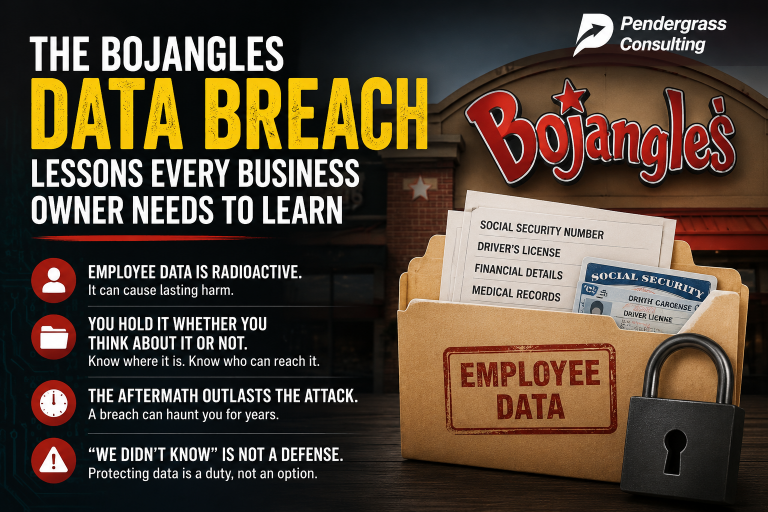
This one is close to home. Bojangles — the Charlotte-based institution with roughly 800 locations — is back in North Carolina headlines this week: a NC Business Court judge just ruled the class action over its 2024 data breach can move forward. Per the lawsuit, more than 387,000 files of EMPLOYEE data — Social Security numbers, driver’s licenses, financial details, medical records — were taken and shared on the dark web. The breach lasted three weeks. The fallout is in its third year. Here’s what every employer, large or small, should take from it — because you hold this exact data too.

Tomorrow is the Fourth of July, and you’ve earned the break — the grill, the family, the fireworks. But here’s a thought worth holding onto over the grill: even though you’re off the clock, one part of your business never will be. Your website is the one employee that never takes a holiday — working at 2pm on the 4th while a customer searches for exactly what you offer. The only question is whether it’s working for you or quietly turning them away. Here’s how to make sure yours does you proud.

Yesterday, visitors to one of the world’s largest ‘residential proxy’ providers found an FBI seizure banner where the homepage used to be. Google, the FBI, and Lumen moved to dismantle the NetNut network — built on at least 2 MILLION everyday devices, mostly smart TVs and streaming boxes, quietly routing strangers’ traffic through the homes and businesses where they sat. In one week, Google watched 316 criminal and espionage groups use it. Here’s what a residential proxy network is in plain English, how the devices got recruited, why your address takes the blame, and the question every owner should ask: what’s plugged into my network right now?

Tomorrow is International Joke Day — and it makes a surprisingly useful question to put to every business owner: when a customer lands on your website, is it making the impression you think it is, or is it quietly the punchline to a joke you can’t hear? Your great work is the setup. A dated, slow website ruins the delivery. And you’re the one person in the world who can’t judge your own site fairly. Here’s how to stop being the punchline — with an award-winning website, live in about a week.

There was a real win for the good guys this week: an international operation dismantled hundreds of criminal servers and recovered roughly 27 million stolen login credentials. But underneath the good news is a sobering truth. That mountain of stolen passwords wasn’t taken in some dramatic hack of a big company — it was harvested a few victims at a time from regular people’s computers, through one of the most ordinary and avoidable mistakes there is. And the takedown does almost nothing to stop the same thing from happening to you tomorrow.

One scammer’s trick has quietly become a favorite, and it’s so counterintuitive that even careful people fall for it. Researchers call it ClickFix, and it works by doing something no ordinary scam does: it convinces you to attack your own computer, with your own hands, while you believe you’re fixing a problem. There’s no malicious attachment to catch — you do the work yourself. Here’s how the con works, why it fools your most conscientious people, and the one simple rule that defeats every version of it.

Here’s a cybersecurity story with a twist that should make every business owner with a website sit up. In late June 2026, the prediction-market platform Polymarket watched roughly $3 million get drained from its users — but Polymarket itself was never broken into. Attackers compromised one of the outside companies it relied on and used that to slip malicious code onto Polymarket’s own website. To visitors, everything looked normal. It was the real site, at the real address. Here’s why the same weakness exists on nearly every small business website — and how to find out what’s running on yours.

A spy-thriller headline out of Canada carries a very practical warning for ordinary businesses. A court let the country’s intelligence service remotely clean malware off hijacked routers, cameras, doorbells, and TVs sitting in homes and businesses. But the real lesson isn’t the dramatic government operation — it’s that botnets feed on the gear nobody maintains, and even a cleanup doesn’t fix the underlying weakness. Here’s why your forgotten hardware is a target, and why retiring and securing it is on you.