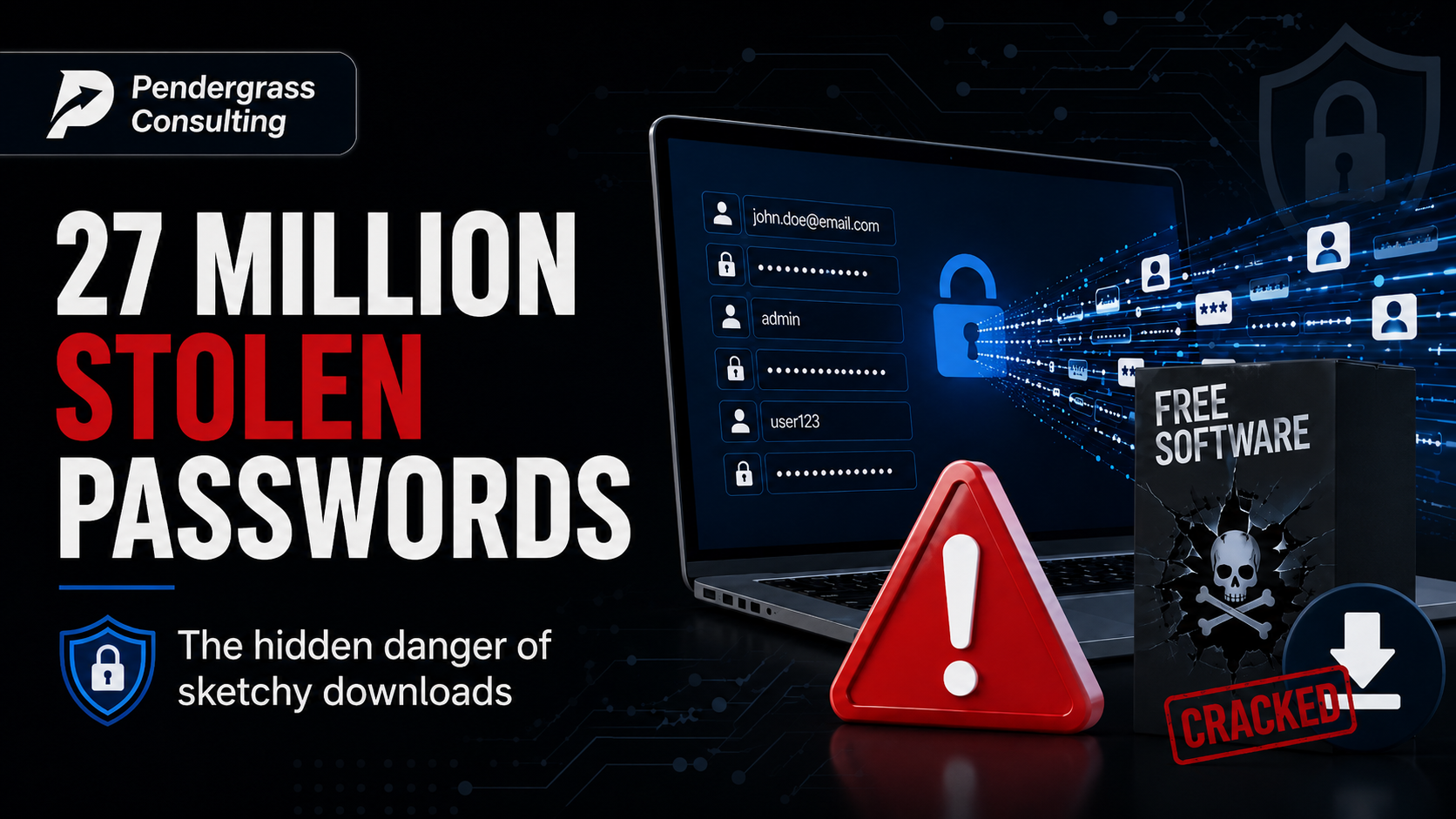
There was a genuine win for the good guys this week. An international coalition of law enforcement agencies, working with major technology companies, struck a serious blow against the cybercrime world. In an operation called Operation Endgame, they dismantled hundreds of the criminal servers behind two notorious pieces of data-stealing software, seized millions in criminal cryptocurrency, and — this is the number that should stop you cold — recovered roughly 27 million stolen login credentials. Twenty-seven million usernames and passwords, lifted from ordinary people and businesses, sitting in criminal hands until this week.
It is a real victory, and the people behind it deserve credit. But underneath the good news is a sobering reality every business owner needs to understand. That mountain of 27 million stolen passwords did not come from some dramatic, sophisticated hack of a big company’s vault. It was harvested, a few victims at a time, from regular people’s computers — through one of the most ordinary and avoidable mistakes there is. And the takedown, as welcome as it is, does almost nothing to stop the same thing from happening to you tomorrow.
Where 27 million passwords actually come from
The software at the center of this takedown belongs to a category called “infostealers,” and the name is exactly right — their entire job is to quietly steal information. Once one of these gets onto a computer, it silently rifles through everything of value: the passwords saved in the web browser, the credit card numbers stored for autofill, the login sessions that keep someone signed into their email and bank, and more. It scoops all of it up and ships it off to the criminals, and the victim typically has no idea anything happened. The computer keeps working normally. There is no dramatic sign. The theft is invisible, which is exactly why these tools are so effective and so popular with criminals.
So how does an infostealer get onto a computer in the first place? Overwhelmingly, the person installs it themselves, without realizing it. They go looking for a free version of expensive software. They download a “cracked” or pirated copy of a program to avoid paying for it. They grab a free tool, a game add-on, a video downloader, a too-good-to-be-true freebie from a search result or an ad. The download promises one thing and quietly delivers the infostealer along with it — or instead of it. The victim went looking to save a few dollars and handed a criminal the keys to their entire digital life. That is the unglamorous truth behind those 27 million passwords: most of them were stolen from people who invited the thief in while trying to get something for free.
Why this is a business-ending risk, not a personal annoyance
It is tempting to think of stolen passwords as a personal headache — reset a few logins and move on. For a business, it is far more serious, because of what those stealing tools are really after and what happens next. When an infostealer hits a computer that is used for work, it does not just grab a personal social media password. It grabs the saved logins to your business email, your banking, your accounting system, your customer records, your cloud files — whatever that computer can reach. And here is the part that makes it genuinely dangerous: the criminals who run these tools usually are not the ones who will use what they steal. They are wholesalers. They harvest credentials by the millions and sell them in bulk to other criminals — including the ransomware gangs who use a valid stolen login to walk straight into a business and lock it down.
That is the supply chain this week’s operation was aimed at. These infostealers are the first link — the tool that quietly gathers the keys — and ransomware and fraud are what comes after, once those keys are sold on. So when an employee downloads a sketchy free program onto a computer that touches your business, the real risk is not a single compromised account. It is that the login to your business gets bundled into a database, sold to the highest bidder, and used weeks later as the front-door key for an attack that takes your whole company down. One person trying to save thirty dollars on software can hand an attacker the way in.
Why the takedown won’t save you
Here is the hard truth inside the good news. Operations like this one are valuable — they disrupt criminal networks, raise the cost of doing business for the bad guys, and rescue data. But they do not fix the underlying problem, because the underlying problem is not the servers. It is the behavior that feeds them. Take down these particular criminals’ infrastructure, and the demand does not vanish; new tools and new servers rise to replace what was seized, often within weeks. As long as people keep downloading risky software and inviting these stealers onto their machines, there will be a fresh mountain of stolen credentials to seize in next year’s operation. The police can keep emptying the bucket, but they cannot turn off the tap. Only you can do that, on your own machines, by changing the behavior that fills it.
And you cannot count on being rescued. The 27 million credentials recovered this week are a fraction of what is out there, and the vast majority of stolen logins are never recovered, never returned, and quietly used against their owners. Counting on a future police operation to claw back your stolen passwords is not a security strategy. Not getting robbed in the first place is.
The fix is a habit, not a product
The genuinely good news is that the behavior at the root of all this is completely within your control, and it costs nothing to change. The single most protective habit any business can build is simple to state: software gets installed only from legitimate, official sources, and the temptation of “free,” “cracked,” or “too good to be true” downloads is treated as the red flag it almost always is. A free copy of expensive software is not a bargain; it is the most common bait in the entire infostealer playbook. An employee who understands that — who feels a flicker of suspicion instead of excitement when a free version of a paid program appears — is a business that has shut off the tap those 27 million passwords flowed through.
That understanding does not happen by accident, especially across a team of busy people who are just trying to get their work done and save the company a little money. It comes from training — real, plain-language training that helps every person on your team recognize the bait, understand what is actually at stake when they download the wrong thing, and build the instinct to stop. That is the work we do, and it is the cheapest, highest-return security investment a small business can make, because it shuts down the single most common way businesses get robbed before the theft ever begins. Law enforcement did their part this week. The question is whether the people in your business are quietly filling next year’s bucket — or whether someone has taught them not to.
Sources: Europol; The Hacker News; BleepingComputer; Help Net Security, June 2026.