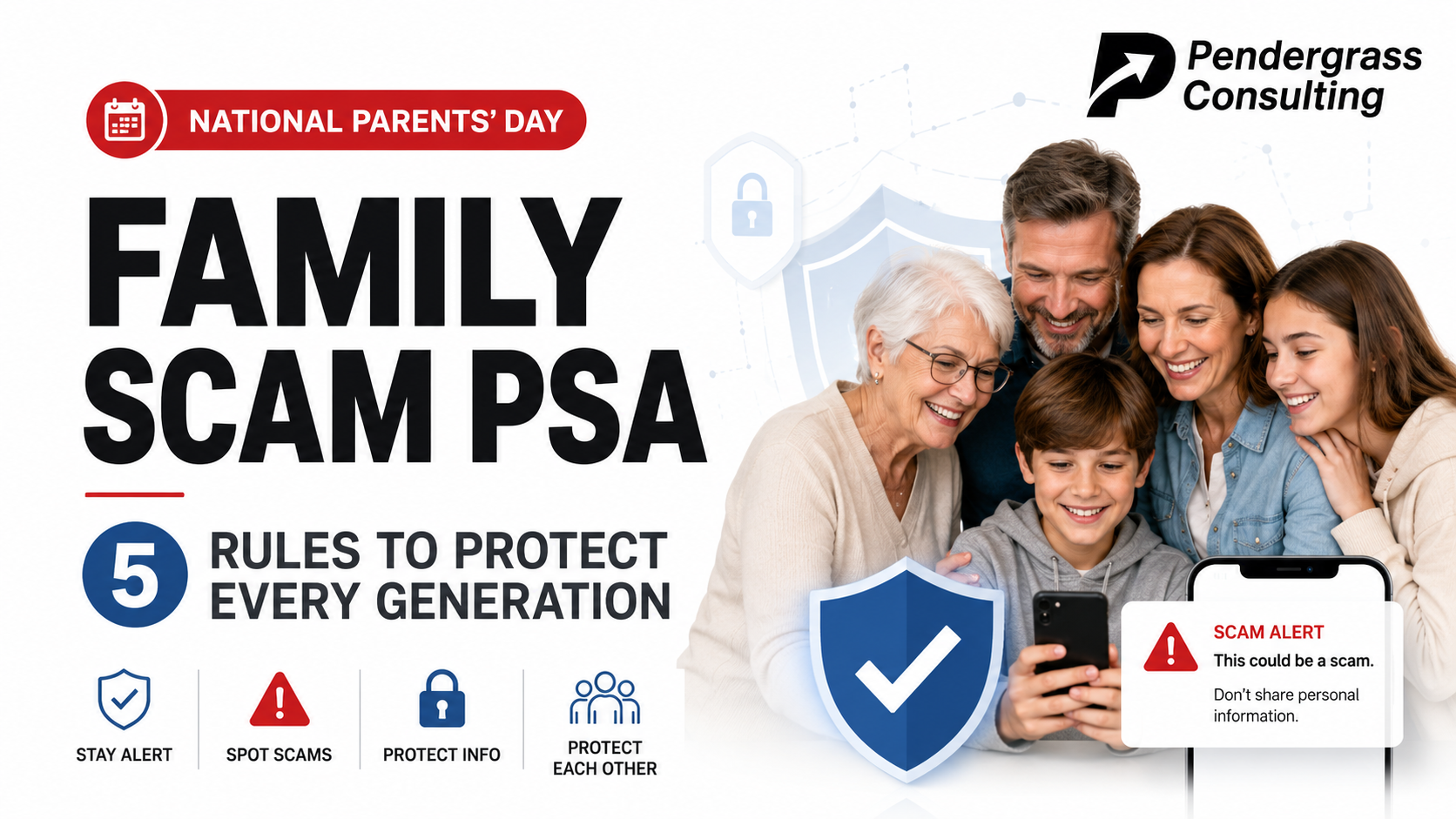
This Sunday is National Parents’ Day — the fourth Sunday of July, the day that rolls Mother’s Day and Father’s Day into one thank-you. And we’d like to suggest a gift for the family that costs nothing, takes about ten minutes, and might be the most valuable thing you give them all year: one short conversation about the scams aimed at families right now. Consider this post the study guide — who’s being targeted, exactly what the bait looks like for every generation at the table, and the five agreements that beat all of it.
Why families are the target: scammers long ago figured out that the fastest way to open a wallet is not greed — it’s love plus urgency. “Your grandchild is in trouble and there’s no time to think” defeats smart, careful people every single day, because it is designed to hit the one button that overrides judgment. The defense isn’t technology. It’s a family that agreed, in advance, on how it handles emergencies — and knows what the bait looks like before it arrives.
The calls hitting families right now
| The scam | How it arrives | The giveaway |
|---|---|---|
| The grandparent emergency, 2.0 | A panicked call: your grandchild’s actual voice, begging for bail or accident money — “and please don’t tell Mom and Dad.” AI can now clone a voice from about three seconds of audio pulled from one social media clip, and caller ID can be faked to match. | Real emergencies survive a callback. Secrecy plus urgency plus money never comes from family. |
| The fake fraud department | “This is your bank’s security team — we’ve detected suspicious charges.” They sound calm and professional, and they “helpfully” walk you into moving money to a “safe account.” | Banks never ask you to move money to protect it. Hang up; call the number on the back of your card. |
| The government call | Social Security, Medicare, the IRS, even “the sheriff’s office about missed jury duty” — always with a penalty about to land unless you pay right now. | Government agencies send letters. They do not call demanding same-day payment, ever. |
| The tech support pop-up | A blaring warning fills the screen — “your computer is infected, call Microsoft now” — and the friendly technician wants remote access and payment. | Real companies don’t put their phone number in a pop-up. Close the browser; nothing was ever wrong. |
The text message trap: smishing 101
Phishing by text message — “smishing,” and yes, that’s really the industry term — has exploded, because texts feel personal, arrive with urgency built in, and get read within minutes. Every phone in your family is receiving these. Here is the current lineup:
| The text | What it says | The tell |
|---|---|---|
| The stuck package | “USPS: your package is held due to an incomplete address — click to reschedule delivery” (a small “redelivery fee” collects your card) | Carriers don’t text payment links. Track packages only on the carrier’s real site or app. |
| The unpaid toll | “Final notice: your unpaid toll balance will be sent to collections — pay now to avoid penalties” — a wave that has hammered North Carolina phones this year | Toll authorities bill by mail and through their official site. The link and the urgency are the scam. |
| The bank alert | “Did you authorize a $743 purchase? Reply YES or NO” — any reply triggers a follow-up call from the “fraud department” | Don’t reply at all. Call the number on the back of your card and ask. |
| The wrong number | “Hey, is this still Amanda’s number?” — an innocent mistake that becomes a friendly chat that becomes, weeks later, an investment opportunity | Strangers who keep talking after “wrong number” aren’t lonely. They’re working. |
| “Hi Mom, new number” | A text claiming to be your kid: phone broken, new number — then a few messages later, an urgent bill or transfer they need help with | Call the old number. The “broken phone” answers. |
| The verification code | “Your account code is 583911” followed by a message or call asking you to read it back “to verify your identity” | Anyone asking you to share a code IS the break-in. Codes are for entering, never for telling. |
The three smishing rules for every phone in the house: Never tap a link in an unexpected text — go to the app or website yourself. * Never reply, not even “STOP,” to a scam text — replying confirms a live number; just delete it and report it as junk (you can also forward scam texts to 7726, which reports them to carriers). * And treat every text about money, packages, tolls, or accounts as guilty until you verify it through the front door.
Every generation has a target on its back
Here’s what most families never talk about: the scams are age-targeted. The bait dangled in front of Grandma is not the bait dangled in front of your teenager — each generation gets lures engineered for its habits, its pressures, and its blind spots. Walk the whole table through all three, because the strongest family defense is everyone recognizing everyone else’s traps.
Grandma & Grandpa: targeted for savings and politeness
Older adults hold the deepest savings, grew up answering the phone politely, and were raised to respect authority — and the numbers show it: Americans over 60 reported $7.7 billion in losses in the FBI’s most recent annual report, up 59 percent in one year.
| Top lures | The grandparent emergency call * fake bank fraud departments * Social Security / Medicare / IRS impersonation * tech-support pop-ups * romance scams that grow for months before the “emergency” ask |
| Why it works on them | Politeness keeps them on the line * authority voices carry weight * they’re reachable at home during the day * and shame keeps victims quiet, so the same person gets hit again |
| Teach them this | It is never rude to hang up on a stranger * no real agency or bank demands same-day payment * gift cards are never how anything official is paid * and there is zero shame in checking with family first — that’s what the code word is for |
Mom & Dad: targeted for busyness and money in motion
Working parents are the sandwich generation of scam targets: they have mortgages, bills, kids’ activities, and jobs — which means money constantly in motion, and attention constantly divided. Their scams are engineered to slip into a busy day looking like one more routine task.
| Top lures | Toll, package, and bank smishing * fake school and activity fee emails * “your streaming account is suspended” notices * fake invoices and subscription renewals * and at work: the “boss needs gift cards” email and vendor payment-change requests |
| Why it works on them | They pay real bills online all day, so one more payment link doesn’t stand out * urgency stacks neatly onto an already-rushed life * and family and work inboxes blur together on the same phone |
| Teach them this | Pay bills only through the front door — the app or site you navigated to yourself * treat every payment-change request (at home or work) as unverified until confirmed by a phone call to a known number * and let the ten-second pause be the habit: “the pressure IS the scam” |
Kids & teens: targeted for trust and inexperience
Kids live online, trust their platforms, and are handling money — game currency, marketplace sales, first paychecks — for the very first time. Their scams arrive inside games, DMs, and group chats, which means parents never see them. That’s exactly why they need the talk.
| Top lures | Free game currency, skins, and giveaway links * “your account will be banned — verify now” messages * marketplace buyers who overpay and want a refund * first-job offers requiring a “training kit” or “equipment fee” * a friend’s hacked account sending “is this you in this video?” links |
| Why it works on them | The message arrives inside a platform they trust * fear of losing an account or a deal moves fast * they don’t yet know what “normal” looks like for jobs and payments * and they’d rather fix a mistake quietly than tell a parent |
| Teach them this | Free currency links are always fake * platforms never DM asking for your password or a code * anyone who sends money and asks for some back is scamming * and the most serious one: if a stranger or “new friend” online ever asks for private photos and then threatens them — they are not in trouble, they will not be punished, and telling you immediately is exactly the right move. Predators rely on a kid’s silence; take that weapon away in advance. |
The 10-minute talk: five family agreements
- 1. Pick a family code word. One word, agreed on out loud, known to everyone from Grandma to the teenagers — and never posted anywhere. Any emergency call asking for money gets one question: “What’s the word?” A cloned voice doesn’t know it.
- 2. Agree on the callback rule. No matter how real it sounds, hang up and call the person back on the number already saved in your phone. A real emergency survives a sixty-second callback. A scam dies on the spot.
- 3. Make the gift-card rule absolute. Nobody legitimate — not bail, not a hospital, not the IRS, not tech support — is ever paid in gift cards, wire transfers, or crypto. The payment method alone is the verdict.
- 4. Name urgency as the enemy. Teach the phrase out loud: “the pressure IS the scam.” Anything that cannot wait ten minutes for a verification call is, almost by definition, fake.
- 5. Build a no-shame checking culture. Agree, as a family, that it is always okay — always — to hang up, double-check, and ask someone. That covers Grandma calling you about a “bank” call, and it covers your teenager telling you about a threat online. Scams and predators alike survive on silence. Families that talk don’t get taken.
Picking a good code word: make it memorable but impossible to guess — an inside joke, the name of a long-gone pet, the dish Grandma burned that one Thanksgiving. Not a birthday, not a street, not anything living on social media. Say it out loud at Sunday dinner, make the teenagers repeat it, and write it nowhere. That’s the whole system — and it beats a million dollars of scam technology.
The fridge sheet: if you see this, do that
Print this part. Stick it somewhere the whole house walks past.
| If you see… | Do this |
|---|---|
| A family emergency call asking for money | Ask for the code word. Then hang up and call their saved number. |
| Any text with a link about money, packages, tolls, or accounts | Don’t tap. Don’t reply. Go to the real app or site yourself. |
| Anyone — anyone — asking to be paid in gift cards, wire, or crypto | It’s a scam. Full stop. Hang up. |
| A “bank” or “agency” call demanding action today | Hang up. Call the number on your card or statement. |
| A message asking you to read back a verification code | Never. Codes are for entering, not for telling. |
| Anything that makes your heart race and demands speed | That feeling is the alarm. Wait ten minutes. Verify. Then decide. |
Business owners: same talk, second payoff
Here’s a bonus for everyone reading this who is both a parent and a business owner — which around here is most of you. Every instinct in that ten-minute talk is the same one that protects your company. The “grandchild in trouble” call is the same play as the “boss needs gift cards before the meeting” email. The cloned family voice is the same technology now used to impersonate executives and vendors on the phone. The toll text that fools a tired parent is the same reflex-hijack as the fake invoice that fools a tired bookkeeper. The callback rule, the payment-method rule, the no-shame verification culture — teach them at your kitchen table on Sunday, and you have taught the exact skills your team needs on Monday. That’s precisely what our focused, plain-language security training builds for businesses: the trained pause, drilled on the real lures your people face, until checking first is a reflex instead of an afterthought.
So this Sunday, between the cookout and the card: ten minutes, five agreements, one code word — and now, one fridge sheet. It’s the rare gift that protects every generation at the table, from Grandma’s savings to your teenager’s first paycheck. Happy Parents’ Day from all of us at Pendergrass Consulting.
Sources: FBI IC3 2025 Internet Crime Report; FTC consumer alerts on AI family-emergency scams and smishing; FCC scam alerts, 2026.