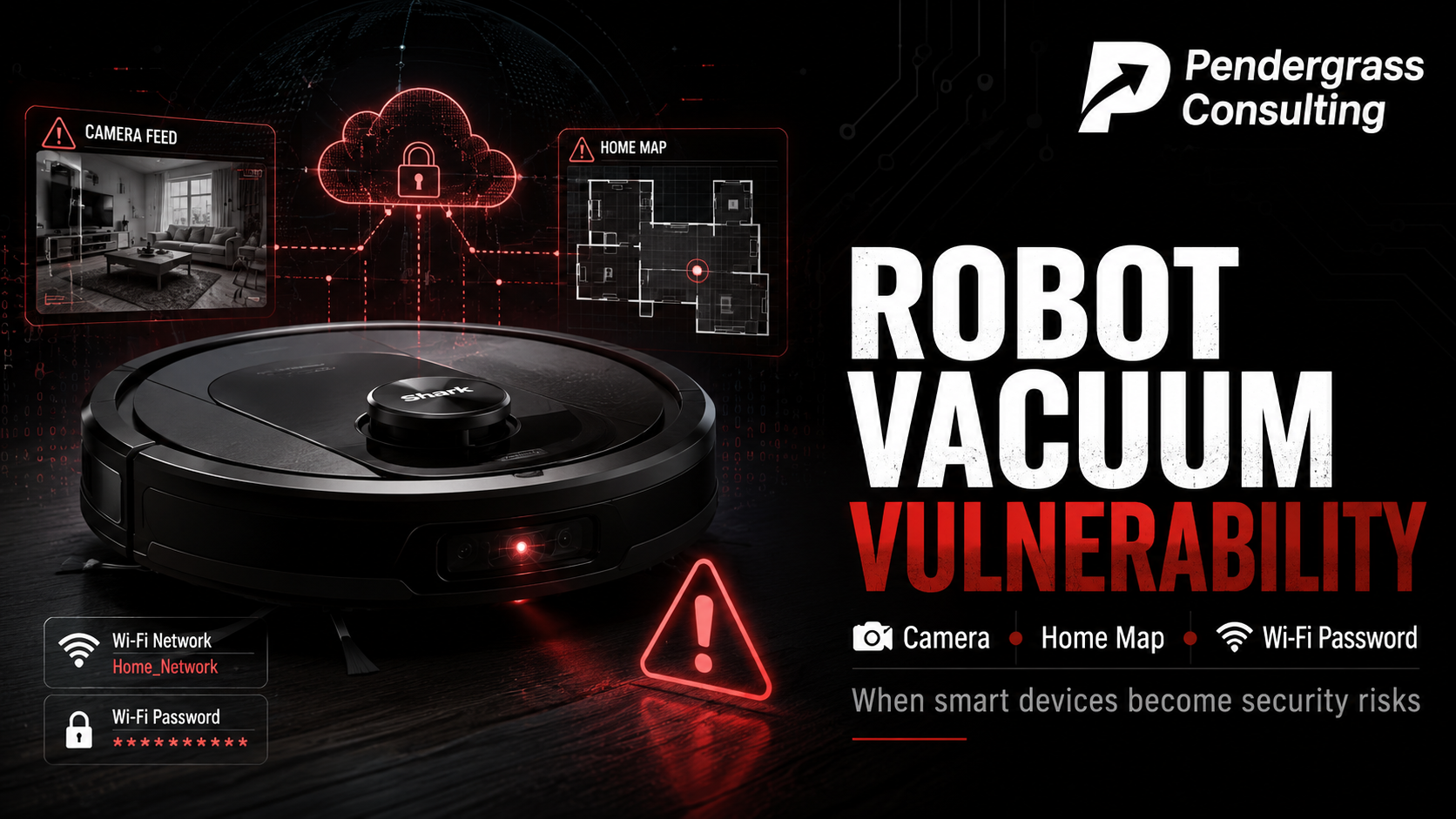
Here is a story that sounds like a joke and absolutely is not. A security researcher took apart a Shark robot vacuum — the popular little disc that cleans floors in millions of homes and offices — and pulled out the digital ID it uses to talk to the company’s cloud. With that one ID from one vacuum, he found he could send commands to other people’s Shark vacuums across the same cloud region. Not just “start cleaning” commands: by his account, the access could let someone watch through a vacuum’s camera, drive it around, read the map it has drawn of the home, and lift the Wi-Fi password it stores — in plain, readable text.
To gauge the scale, the researcher sent a harmless status request and, within 24 hours, more than 673,000 devices answered. He says he tested actual commands only against vacuums he bought himself, and that he reported the problem to the manufacturer back in March — but as of his publication this week, it remained unfixed. We will let the vendor and researcher sort out that timeline. Our job is the lesson underneath, because it applies to every smart gadget in your home or business, not just one brand of vacuum.
The story, at a glance
| The find | A researcher extracted the digital ID from one robot vacuum — and the cloud accepted it as valid for commanding other vacuums, not just the one it came from |
| The scale | 673,816 devices responded to his status check within 24 hours |
| What’s at stake per device | The camera, remote control of the robot, the stored map of the home’s layout — and the Wi-Fi password, stored in plain text |
| The root cause | One device’s key was never limited to that device — effectively a master key riding inside every unit |
| Status | Reported to the manufacturer in March, unfixed at publication, per the researcher — who tested commands only on his own devices |
One key for the whole neighborhood
Strip away the technology and the flaw is embarrassingly simple. Every vacuum carries a key so it can talk to the company’s cloud. The proper design gives each device a key that works only for itself. Here, according to the research, the key was never restricted that way — so the cloud would accept commands from any key, aimed at any device it serves. It is the digital equivalent of every house on the street being fitted with the same master key, and a copy of that key being taped inside each front door. Pry one loose, and the street is yours.
The lesson in one line: the gadget you never think of as a computer is a computer you never think about — and this one is holding a camera, a map of your building, and the password to your network.
Take inventory of what your gadgets actually know
Set the vacuum aside and look at the pattern, because it is the same one behind the hijacked smart TVs, the botnet-recruited cameras, and every other connected-gadget story this year. A “smart” device is a full computer — with sensors, storage, and your network credentials — wearing an appliance costume. The vacuum knows your floor plan and your Wi-Fi password. The doorbell watches your entrance. The TV listens for its wake word. The thermostat knows when the building is empty. Each one was carried in, plugged in, connected to the network that also carries your email, your files, and your payments — and then never thought about again. You cannot patch a flaw the vendor has not fixed. What you can control is which devices you allow in, what they sit next to on your network, and whether anyone can even say what is connected.
The honest questions: Could you list every smart device connected to your business or home network right now? * Do the gadgets share the same network as the computers that hold your real valuables? * For each device: what does it know — camera, microphone, layout, passwords — and what would it give away? * And when a device’s maker stops fixing problems, who in your world would even know?
Those questions are exactly what our environment review answers, in plain language: every device on your network, what each one can see and reach, whether the risky ones are properly separated from the valuable ones, and where the quiet exposures are. Six hundred seventy-three thousand vacuums answered a stranger’s knock in a single day. The better question is closer to home: if someone knocked on your network right now, what would answer — and do you even know its name?
Sources: independent researcher publication via The Hacker News, July 2026. Findings and vendor-timeline claims are as reported by the researcher, who tested only devices he owned.