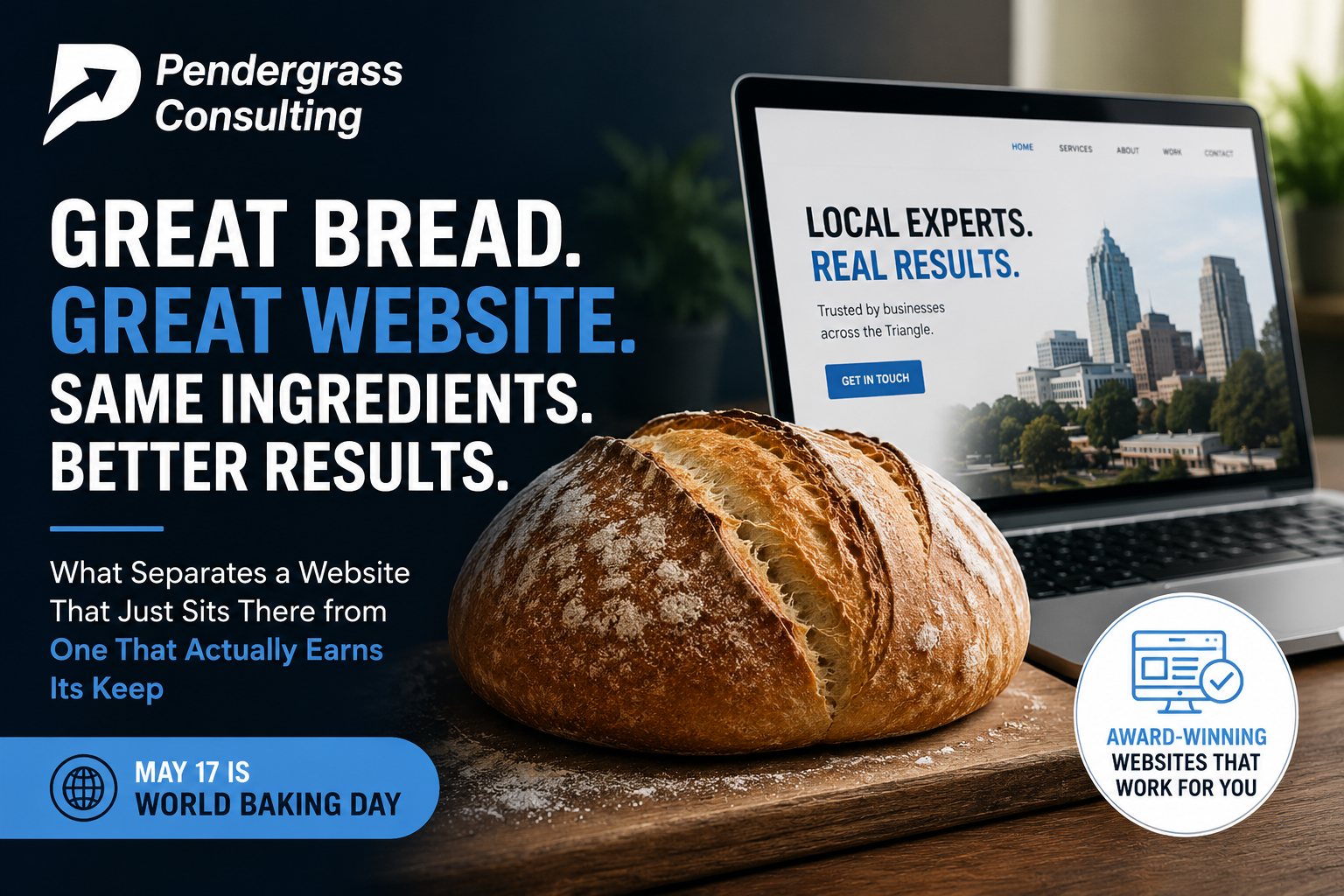
May 17 is World Baking Day. It is one of those small holidays that does not get a lot of attention, but it deserves more than it gets – because anybody who has ever tried to bake a great loaf of bread knows that the difference between a loaf that comes out of the oven looking and tasting like it belongs in a magazine and a loaf that comes out flat, dense, and disappointing is not a mystery. It comes down to the right ingredients, the right technique, and someone who has done it enough times to know exactly what to look for.
The same is true of a website.
Almost every small business has a website. Almost every owner can name something they wish their website did better. And almost none of them know exactly why their website is not delivering what they hoped it would. The answer is usually the same answer that produces a bad loaf of bread: cheap shortcuts, missing steps, or somebody who never really knew what they were doing in the kitchen.
On World Baking Day, we thought we would take a few minutes to walk through what separates a website that just sits there from a website that actually earns its keep – and why so many small businesses end up with the wrong one without ever realizing it.
Why Most Small Business Websites Underperform
Walk into any small business in Raleigh, Cary, Selma, or anywhere else in the Triangle, and ask the owner how their website is doing. Most of them will pause. They will say something like “it is fine” or “I have not really looked at it lately” or “we have been meaning to update it.” That pause is the tell. It means the website is not actively working for the business – it is just sort of sitting there, like a loaf of stale bread on the counter.
The signs are usually the same:
❌ People cannot find it when they search. A potential customer looks for a business like yours, and a competitor shows up instead. Or worse, nothing shows up at all.
❌ It looks dated. Visitors land on the site, and within three seconds they have made a judgment about how seriously to take the business behind it. Outdated design tells them this is not a business that pays attention to details.
❌ Nobody fills out the contact form. The traffic exists, but it does not convert. People arrive, look around, and leave. The website is asking them to do something, and they are not doing it.
❌ It does not work well on phones. A meaningful share of every visitor is on a mobile device. If the site is hard to read, hard to navigate, or just plain broken on a phone, that visitor is gone.
❌ It has been forgotten. The last update was years ago. Phone numbers are wrong. Services are missing. The “latest news” section is from 2022.
None of these problems are obvious from inside the business. The owner knows the company is good. The owner knows the work is excellent. The owner has years of happy customers as proof. But the website does not communicate any of that to a stranger searching online – and a stranger searching online is exactly who you need to reach.
What an Award-Winning Website Actually Does for a Small Business
A great website does not just look good. A great website earns its keep. For a small business, that means doing four specific things, day after day, whether anyone is watching it or not.
01
It Gets You Found
When someone searches for a service your business offers, your website should be one of the first results they see – not buried on page three behind competitors with deeper pockets. A great website is built from the ground up to be found by the right people at the right time. Not by being louder than everyone else, but by being clearer, more relevant, and more trustworthy.
02
It Builds Trust Instantly
Visitors decide whether to take a small business seriously almost instantly. The look, the feel, the speed, the writing, and the clarity of what the business actually does are all working together in those first moments. A great website earns the visitor’s trust before they have even finished reading the homepage – because it looks like the kind of business they would feel comfortable hiring.
03
It Makes Reaching Out Effortless
The biggest failure of most small business websites is that they make it hard to take action. Phone numbers buried at the bottom. Contact forms with too many fields. Vague calls to action. A great website assumes the visitor is busy, gives them an easy and obvious way to reach the business, and removes every speed bump between “interested” and “in touch.”
04
It Works While You Sleep
A great website is not finished when it launches. It is the foundation. From that point forward, it should be continuously improving – getting faster, ranking higher, capturing better leads. While the owner is busy running the business, the website should be doing the unglamorous work of putting new prospects in front of the business every single day.
That is the difference between a website that exists and a website that earns its keep. The first one is a line item. The second one pays for itself.
The Two Kinds of Small Business Website
Almost every small business website falls into one of two camps. The honest test of which one your business has is to ask whether it would matter, financially, if the website went offline tomorrow. If the answer is “not really,” you have the first kind. If the answer is “we would feel it within a week,” you have the second.
A Website That Exists
Built from a generic template. Looks like a hundred other small business websites. Has not been updated in years. Buried on page three of search results. The contact form rarely gets filled out. Phone calls trickle in from word of mouth, not from the website. The owner pays the monthly hosting bill but cannot really say what the website is doing for the business.
It is a line item. A small one, but a line item.
A Website That Earns Its Keep
Designed around the actual business it represents. Looks current, loads fast, reads cleanly on every device. Shows up when the right people search. Visitors land on it and stay long enough to take the next step. Contact forms get filled out. Phone calls come in from people the owner has never met. New customers arrive from places the owner did not know were paying attention.
It is an employee. One of the best ones the business has.
The difference between the two is not luck. It is not budget either – some of the best small business websites we have built were not the most expensive. The difference is whether someone put the work in, knew what to look for, and treated the website like it actually mattered.
How a Website Turns Into Actual Leads
The most common question we hear from small business owners is the most honest one: “But will it actually bring me business?”
The answer is yes, but only if it is built right. A well-designed website turns into leads through a series of small wins that compound over time. Someone searches for what your business offers. They find your site. They like what they see. They trust the look and feel enough to read further. They find the answer to the question they were silently asking. They reach out – by phone, by form, by email, or by walking through the door. Every one of those steps is the result of a deliberate choice somewhere in the design and build. None of them happen by accident.
For a small business, the difference between a website that generates two or three good leads a month and a website that generates twenty is not luck. It is whether someone put the work in.
Why the Right Partner Matters More Than the Right Vendor
Plenty of companies will build a small business a website. Most of them are vendors. A few of them are partners. The difference matters more than most owners realize.
A vendor builds the site, sends the invoice, and moves on. If something breaks, you file a ticket and wait. If you want to make a change, it is a separate project with a separate cost. If your business needs digital marketing, you hire someone else. If you need hosting that does not crash during your busy season, you hire someone else. If you have a security concern, you hire someone else. The website becomes a patchwork of vendors who do not talk to each other, and the owner becomes the project manager whether they want to be or not.
A partner is different. A partner builds the site, but the relationship does not end there. A partner picks up the phone when something is off. A partner knows your business well enough to suggest improvements before you have to ask. A partner sits down with you every quarter to review what is working, what is not, and what comes next. A partner brings the digital marketing, hosting, security, and support under one roof so you do not have to coordinate between five different companies who all blame each other when something goes wrong.
“We do not put our recipe on the internet, and our clients appreciate that. What we do is have an honest conversation about your business, what you need your website to actually do, and what a clear plan looks like to get there.”
How Pendergrass Consulting Helps
Pendergrass Consulting is based in the Research Triangle and builds custom websites for small businesses across our local community and well beyond it. Our web design portfolio includes clients across North Carolina, several other states, and internationally – including ongoing work for businesses in Jamaica. Web design is one of the services we deliver nationally and globally, while our managed IT, on-site support, and on-location photography stay focused on the Triangle.
Every site we build is created from scratch around the business it represents – never from a cookie-cutter template, never as a one-size-fits-all package.
What you get when you work with us:
✅ A custom-built website designed around your business, not a template forced to fit it
✅ An honest plan with no surprise fees and no long-term contracts
✅ One team handling design, build, hosting, support, and ongoing improvements
✅ Direct access – when you call, you talk to someone who already knows your business
✅ Quarterly strategy meetings to review what is working and plan what is next
✅ A partner who is invested in your business succeeding, not just in shipping a project and moving on
If your current website is not earning its keep – or if you are still relying on word of mouth, a Facebook page, and a Google Business Profile to bring in new customers – now is a good time to have a conversation about what could be different. The first conversation is always free, and there is no commitment beyond it.
Bake Something Worth Sharing
On World Baking Day, the people who get celebrated are the ones who actually know what they are doing in the kitchen. Not the ones who use shortcuts. Not the ones who follow a recipe they do not understand. The ones who have done the work, made the mistakes, learned what matters, and know exactly how to get from raw ingredients to something worth sharing.
Your website deserves the same kind of attention. If you are ready to talk about what an award-winning website could look like for your business, we would love to hear from you.
Free Website Overview
See how your website measures up across five core areas. Get a high-level overview in under a minute.
Pendergrass Consulting
Phone: 252-432-3325
Email: Sales@PendergrassConsulting.com
110 S. Massey St., Suite 201, Selma, NC 27576
Pendergrass Consulting is a full-service IT firm based in Selma, NC, serving small businesses across the Research Triangle, Raleigh, Cary, Wake County, Johnston County, and delivering web design, hosting, email, cloud backup, and digital marketing services nationally and internationally.