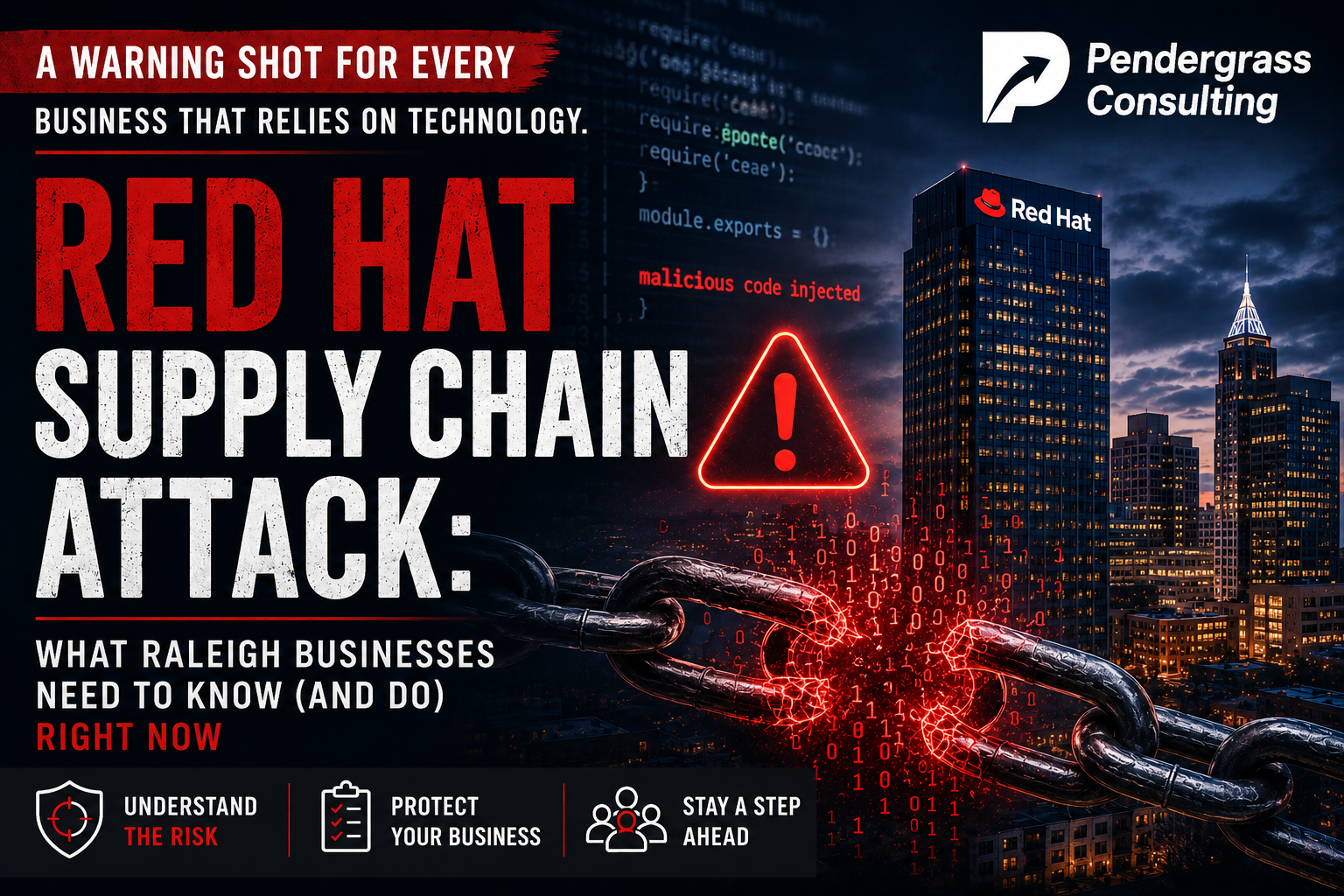
If you do business in the Triangle, you know the name Red Hat. The software giant has anchored downtown Raleigh for years — its name is on the tower over the skyline, it employs thousands of our neighbors, and it is one of the most respected technology companies in the world. So when news broke on June 1, 2026 that attackers had successfully slipped malicious code into Red Hat’s own software packages, it landed close to home. If it can happen to one of the most security-conscious technology companies on the planet, headquartered right here, it raises an uncomfortable question for every business owner in the area: what does that mean for the rest of us?
The short answer is that this attack is a warning shot for every business that relies on technology — which, in 2026, is every business. You do not have to understand a line of code to understand the lesson. Let us walk through what happened and, more importantly, what it means for you.
What actually happened
Modern software is not written from scratch. It is assembled. Even the largest companies build their products partly out of pre-made components — trusted building blocks, published and shared by reputable sources, that thousands of other companies use too. It is a bit like a restaurant that makes everything in-house but still buys its flour from a trusted mill. Nobody mills their own flour. You trust the supplier, because the supplier has always been reliable.
In this attack — which security researchers named “Miasma” — criminals found a way to poison the flour. They slipped malicious code into more than thirty of Red Hat’s trusted, official software components, the kind downloaded over a hundred thousand times a week by developers around the world. From the outside, the components looked completely normal. They carried Red Hat’s name. They came from the official, trusted source. But anyone who used the tainted versions was unknowingly installing a thief along with the tool.
And here is the part that matters: this was not an attack on Red Hat’s customers’ data, and Red Hat responded quickly, stating the issue was limited to internal development tooling and pulling the bad components as soon as they were alerted. The danger was to everyone downstream who had already trusted and used those components. The attack did not break down the front door. It hid inside a delivery the victim had already agreed to accept.
Why this kind of attack is so dangerous
Most people picture a cyberattack as someone trying to break in — guessing passwords, smashing through firewalls, brute force at the gate. This is the opposite. A supply chain attack does not break in. It walks through the front door carried in the arms of someone you trust. You invited it. You had every reason to. The thing that compromised you was the very thing you were right to rely on.
That is what makes it so effective and so frightening. Your instincts do not fire. There is no suspicious email to squint at, no shady website to avoid, no obvious warning sign to heed. The threat arrives wearing the uniform of a trusted brand, through a channel you have used safely a thousand times before. Once it is inside, this particular breed of malware goes quietly to work — quietly hunting for the digital keys to everything: passwords, access codes, the credentials that unlock cloud accounts and email and financial systems. And it is built to dig in and stay, surviving the obvious attempts to remove it. Worse, it is designed to spread, using what it steals from one victim to reach the next. That is why the researchers named it after a spreading blight. It does not just rob one business. It uses that business as a stepping stone to the others connected to it.
“But I’m not a software company”
Here is where most small business owners mentally check out, and it is exactly the wrong moment to do so. You do not write software, so this feels like a story about somebody else’s world. It is not. The lesson of this attack is not about code. It is about trust — and the uncomfortable reality that the technology your business depends on is built on a long chain of trusted suppliers you never see and never think about.
Think about how much of your business runs on tools and services from outside vendors. Your website and the plugins that power it. Your point-of-sale system. Your accounting software. Your email platform. The apps your team installs to get their jobs done. Every one of those is a supplier in your chain, and every one of them is itself built on still more suppliers underneath. You did not build any of it, and you have no realistic way of personally verifying that every piece is clean. You trust it — exactly as the world trusted Red Hat’s components right up until June 1.
This is the great hidden risk of running a modern small business. The same convenience that lets a five-person company run on the same powerful tools as a five-thousand-person company also means a five-person company inherits the same supply chain exposure — usually without anyone watching it, without anyone whose job is to notice when something in that chain goes wrong. Red Hat had an entire security organization and world-class researchers caught this within hours. The average small business has no one watching at all, and would not find out for months, if ever.
What actually protects a business from this
You cannot personally inspect every component in every tool your business uses — nobody can, and chasing that is a fool’s errand. So the answer is not “be more careful about what you download.” The answer is having someone who actually understands your environment, watches the systems your business depends on, and knows what to do when one of your trusted suppliers turns out to have a problem — which, as this attack proves, is no longer a question of if but when.
That means knowing what your business actually runs on in the first place — which tools, which services, which vendors, and which of them touch your most sensitive information. It means having protection in place that watches for the behavior of a threat already inside, not just threats trying to get in. It means having the ability to respond quickly and decisively when a trusted vendor is compromised, instead of finding out from a customer or a bank months later. And it means having a real plan to recover if the worst happens. None of this is something a busy owner can reasonably do alone while also running the business. It is what a real technology partner is for.
The hard truth this attack drives home is that the businesses still treating cybersecurity as something they will get to eventually are making a bet — that the chain of suppliers they have never examined will keep holding. Red Hat is about as strong a link as that chain gets, and even it had a bad day. The businesses that come through events like this unharmed are not lucky. They are the ones who decided, before anything went wrong, to have someone watching.
Find out where your business actually stands
Most small business owners genuinely do not know what their business runs on, where their sensitive information lives, or what would happen if one of their trusted tools were compromised tomorrow. That is not a failing — it is simply not their job to know. It is ours. And it is the single most valuable place to start.
We offer a straightforward environment review for small businesses: a clear, plain-language look at the technology your business depends on, where your real exposure sits, and what it would take to close the gaps — before an attacker finds them first. No jargon, no scare tactics, no obligation. Just an honest assessment of whether your business is one of the ones with someone watching, or one of the ones quietly hoping the chain holds. After a week like this one, that is worth knowing.
Sources: The Hacker News; BleepingComputer; and research published by Wiz, JFrog, Aikido Security, Socket, Mend, and SafeDep, June 1, 2026.