For twenty-five years, the deal between small businesses and Google was simple. Someone needed a plumber, a dentist, an accountant, a roofer. They typed it into Google. They got a list of links. They clicked one. If your business was on that list, you had a shot at the job. Get your website ranking, show up in the list, win the click, win the customer. That was the game, and a generation of small businesses built their entire online presence around it.
That game is ending. Not slowly, and not someday — right now, in 2026. And most small business owners have no idea it is happening, because from where they sit, nothing looks different. Their website is still up. Their Google ranking has not dropped. And yet the phone is ringing a little less than it used to, and they cannot quite say why.
Here is why. We are going to walk through what has actually changed, what it means for your business, and what you can do about it — in plain English, without the jargon.
The click is disappearing
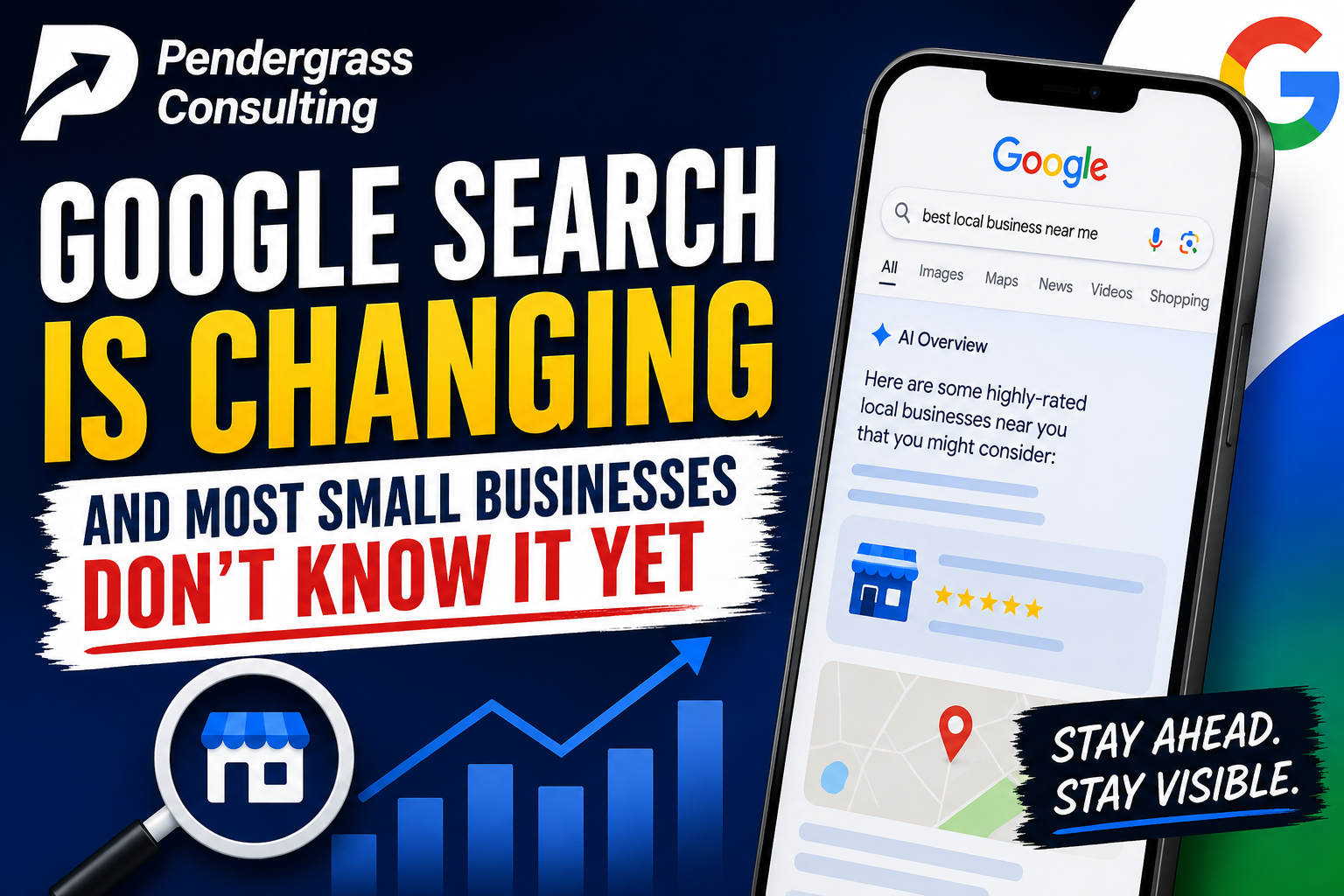
The single biggest change is this: people are getting their answers without clicking on anything anymore. When you search Google today, you often see an AI-written answer sitting at the very top of the page — before any of the usual links. It pulls together information from across the web and hands the searcher a finished answer. For a huge and growing share of searches, that answer is enough. The person reads it, gets what they needed, and never clicks through to a single website. They never visit the businesses the answer was built from.
This is not a small shift. Independent research in 2026 found that when one of these AI answers appears, it cuts the clicks going out to real websites by roughly a third or more — and the majority of Google searches now end with no click to any website at all. Read that again, because it is the whole story in one sentence: most searches no longer send anyone to a business’s website. The list of links you spent years trying to climb is still there. It is just buried under an answer that means fewer and fewer people ever scroll down to see it.
And it is not only Google. A whole generation of customers now opens ChatGPT, Gemini, or Perplexity and simply asks. “Who’s a good roofer near me?” “What should I look for in an accountant?” “Best place for a custom cabinet in the Triangle?” The AI gives them a direct recommendation — a name, sometimes two or three — and the customer goes with it. There is no list to climb. There is no page two. There is just the answer, and either your business is in it or it is not.
Ranking and being recommended are not the same thing
This is the part that catches business owners completely off guard, so it is worth saying clearly. You can be the number-one result on Google for exactly what you do, and still be completely invisible to the AI answer sitting above you. You can rank beautifully and never once get recommended by ChatGPT. The two things run on entirely different logic. The old work of climbing the rankings does not automatically carry over to getting picked by the AI. They are separate races, and the new one is the one your future customers are increasingly running.
Which means a business can do everything it did right for the last decade — have a decent website, hold a solid Google ranking — and still watch its competitors get named in the AI answers while it gets left out entirely. The competitor is not necessarily better at the actual work. They are simply set up in a way the AI trusts and understands, and you are not. That gap is invisible from your desk. The only way to see it is to go looking for it deliberately.
What this is quietly costing you
The danger here is not dramatic. Nothing breaks. No alarm goes off. That is exactly what makes it so costly. The customers who get their answer from an AI and never reach you do not show up as a missed call or a bounced email. They were never a lead you lost, because you never knew they were searching. They simply asked, got a recommendation that was not you, and called someone else. You will feel it eventually — a quarter that is a little softer, a referral pipeline that is a little thinner — but you will not be able to point to the cause, because the cause is invisible by design.
Meanwhile, the searches that still do produce clicks are becoming more valuable, not less. When someone has read an AI summary and still decides to click through to a website, they are far more serious than the old casual browser — they are closer to ready to buy. So the businesses that remain visible in this new landscape are not just holding their ground. They are capturing better, warmer customers than before, while their absent competitors quietly fade out of the conversation. The gap between the visible and the invisible is widening every single month.
Why the businesses that win are winning
Here is the good news, and it is genuinely good. The businesses getting named in AI answers and recommended by ChatGPT are not the biggest or the richest. They are the ones whose online presence is built in a way these new systems can read, trust, and confidently recommend. The AI has to understand exactly what you do, where you do it, who you serve, and why you are credible — and it has to be able to verify all of that from how your business shows up across the web. When everything lines up the way the AI expects, you become the answer. When it does not, you are skipped, no matter how good you are in real life.
Getting there is not about chasing the newest trick, and it is emphatically not a do-it-yourself weekend project anymore. The signals these systems weigh, the way they decide who to trust, and how they verify a business are genuinely complicated, they differ from one platform to the next, and they are changing constantly. This is precisely the kind of work that rewards a professional who lives in it every day and punishes the part-time guesser. The cost of getting it wrong is not a bad afternoon. It is months of being the business the AI never mentions while a competitor gets named instead.
The first step is finding out where you stand
You cannot fix a problem you cannot see, and this one is built to be invisible. So the place to start is simple: find out, honestly, whether your business is showing up in the new search landscape or quietly missing from it. Whether the AI answers in your industry are naming you or naming the competition. Whether your online presence is built to be understood and recommended, or built for a version of search that is fading away.
That is exactly what our website audit is for. In about a minute, it gives you a clear, honest read on how your site stacks up for the way people search today — not the way they searched in 2015. No jargon, no obligation, no sales call required. Just a straight answer to the question every small business owner should be asking right now: when my customers go looking, am I still being found?
The way people find local businesses is changing faster than at any point since Google first existed. The businesses that adapt now will own the next decade of customers. The ones that assume their old ranking will carry them are going to wonder, a year from now, where everyone went. Find out which path you are on — it costs you nothing but a minute, and what you learn could be the most important thing you do for your business this year.