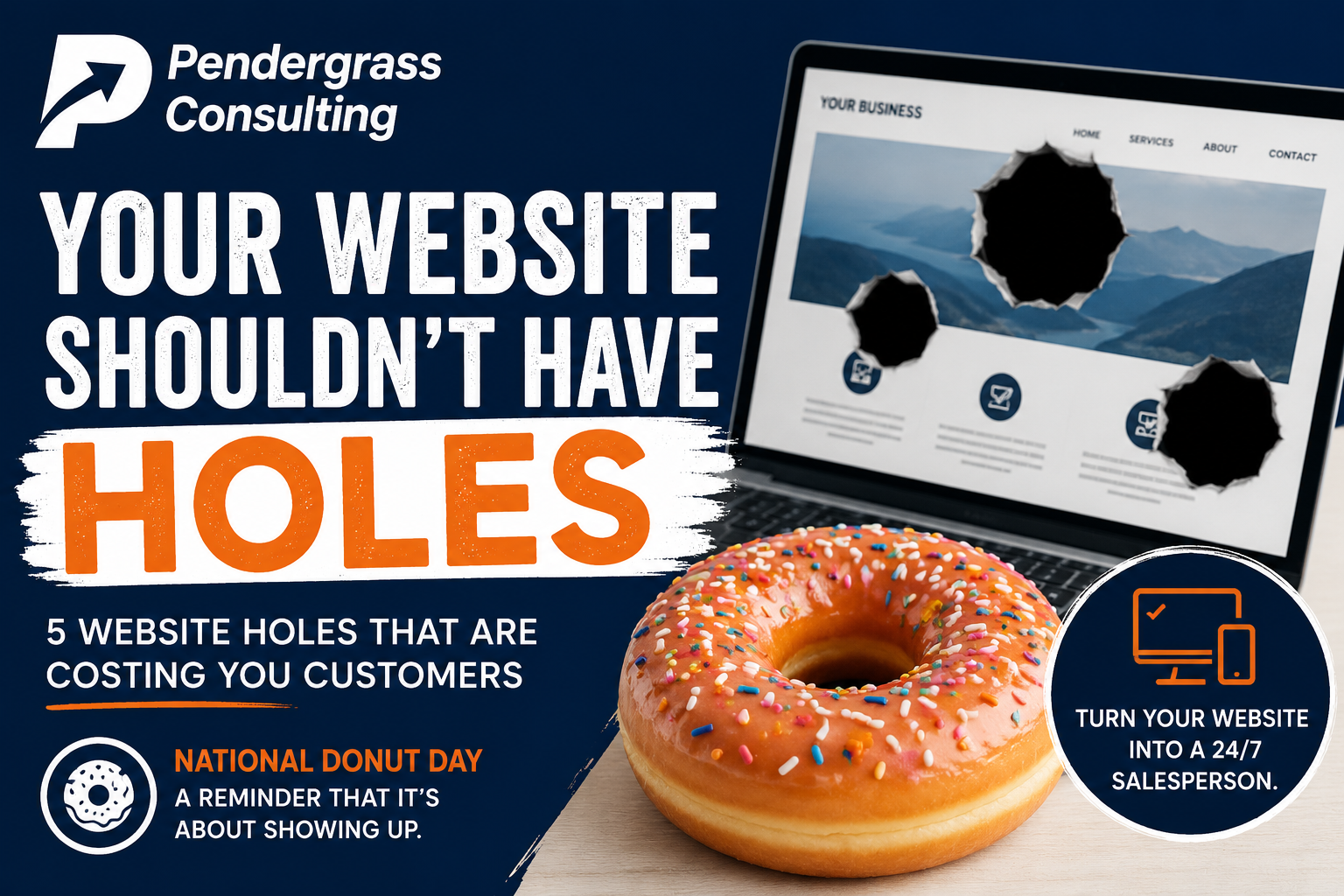
Today is National Donut Day. It started back in 1938, when The Salvation Army set aside a day to honor the volunteers who served fresh donuts to soldiers on the front lines of World War I — the “Donut Lassies.” From the very beginning, the day was never really about the donut. It was about showing up, every day, and taking care of people. That turns out to be a pretty good standard for a small business website, too.
Here is the thing about a donut: it is supposed to have a hole. That is by design. Your website is not. And yet most small business websites are full of holes — quiet gaps that customers slip right through, usually without you ever knowing it happened.
Your website is the hardest worker on your team
Think about who on your team works the longest hours. It is not you, and it is not your best employee. It is your website. It is the one member of your team that never clocks out — working nights, working weekends, working holidays, working at two in the morning when a potential customer is lying awake deciding who to call tomorrow. It is the first impression almost every customer forms of your business before they ever speak to you.
So the real question is not whether you have a website. Almost everyone has a website. The question is whether yours is actually working — whether it is out there earning its keep every day — or whether it is just sitting there looking pretty while the phone stays quiet. Because those are two very different things, and the gap between them is measured in customers you never got the chance to win.
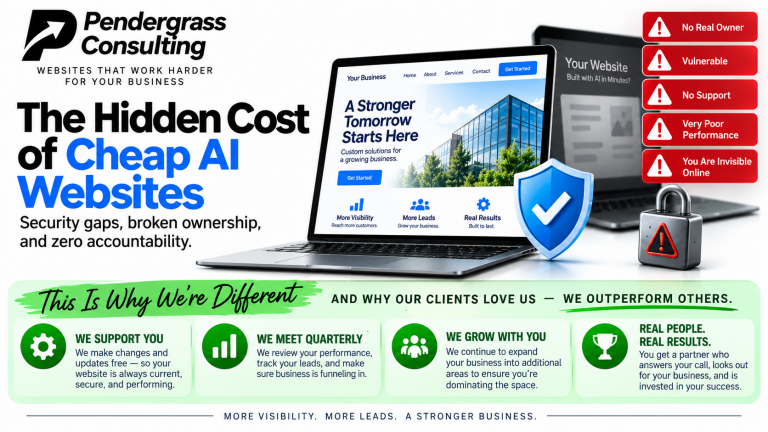
A website that just looks nice is a brochure. A website that works is a salesperson. And most small businesses are paying for a brochure while their competitors are running a salesperson. Here are the holes that make the difference — and what each one is quietly costing you.
The hole that loses customers before they ever see you
A slow website is the most expensive hole of all, because it costs you customers you never even know existed. When someone clicks through to your site and it makes them wait, most of them are gone before your homepage finishes loading. They do not call. They do not complain. They do not give you a second chance. They simply go back and click the next business on the list — which is to say, they call your competitor. You see none of it. There is no missed-call notification for the customer who left before the page loaded. The cost is invisible, which is exactly what makes it so dangerous: you cannot fix a leak you cannot see, and you cannot win back a customer you never knew you lost.
The hole that makes you invisible
You can have the most beautiful website in your county and it will do you no good at all if customers cannot find it when they go looking. Most people choosing a local business do not browse. They search — and then they call one of the first names they see. If your business is not among those names, you are not in the running. It does not matter how good you are, how fair your prices are, or how many happy customers you have. The customer who needed exactly what you offer found someone else, because that someone else showed up and you did not. Being invisible online is not a minor inconvenience. It means watching work you could have done go to a competitor who is not better than you — just easier to find.
The hole that wastes every visitor you do get
Let us say someone does find you, and your site loads fine, and they are interested. What happens next? On too many small business websites, the answer is: nothing. The visitor reads a little, nods, and leaves — because the site never gave them an obvious, easy reason to pick up the phone or reach out right now. Every one of those visitors was a lead. They were interested enough to show up. And the website let them walk back out the door. A site that does not turn visitors into conversations is not a salesperson at all. It is a greeter who waves people in and then watches them wander out the back, and it is wasting the single hardest thing in business to earn: someone’s attention.
The hole that makes you look smaller than you are
This is the one that stings, because it has nothing to do with how good you actually are. Before a customer ever meets you, they have already sized you up based on your website. A site that looks dated, thrown-together, or neglected tells them — fairly or not — that your business might be the same. And so an excellent business with a weak website loses work to a mediocre business with a sharp one. It happens every single day. Your website is your handshake, your storefront, and your reputation, all rolled into the thing a stranger judges you by first. If it does not look like the serious, credible operation you have built, it is actively working against you — making you look like less than you are to the exact people you most want to impress.
The hole that whispers “maybe they closed”
A website frozen in time — last updated years ago, with old information and a copyright date from another era — sends a quiet but corrosive message: maybe this business is not really paying attention anymore. Maybe they are winding down. Maybe they are gone. Customers will not ask. They will just hesitate, and then they will choose the business that looks alive and engaged. A website is not a thing you build once and forget. It is a living representation of your business, and when it goes stale, your reputation goes stale with it — in the eyes of people who have never met you and are making a snap judgment with nothing else to go on.
What a website should actually do for you
Picture the opposite of all of that. A website that loads the instant someone arrives, so nobody slips away waiting. A website that shows up when your customers go looking, so you are in the running for every job in your area. A website that takes an interested visitor and turns them into a phone call, a form, a booked appointment — a real lead, not a missed opportunity. A website that looks every bit as serious, capable, and trustworthy as you are, so the first impression works in your favor instead of against it. A website that makes the kind of business owner you want as a customer look at you and think, “these people are the real deal.”
That is not a brochure. That is the hardest-working, best-paid salesperson you will ever hire — one that works around the clock, never takes a day off, and never asks for a raise. That is what a website is supposed to be. And building one that performs at that level, day in and day out, is a craft. It is the difference between a donut someone fried in their kitchen and one that comes out of a real bakery. Both are donuts. Only one is going to keep people coming back.
Let’s build you one that works
This is what we do. We build websites for small businesses that do not just look good — they perform, every single day, capturing leads and driving real business while you focus on running the company. We build them to the standard that turns heads, that makes you stand out as the serious and credible business you are, and that makes the right customers want to work with you. Not templates. Not cookie-cutter layouts. A site built specifically for your business, by a partner who answers the phone when you call.
If you have read this far, some part of you already suspects your website is not pulling its weight. The good news is that is a fixable problem — and the conversation costs you nothing. Call us. We will give you a straight, honest answer about whether your website is working as hard as you are, and what it would take to build one that does. This National Donut Day, do not leave a hole in the hardest worker on your team.