You may have seen the headline this weekend: Japan has declared a “state of emergency in cyberspace.” It spread fast, and it’s not wrong to be alarmed — more than 20 major Japanese companies have disclosed cyberattacks in a matter of weeks, exposing records belonging to millions of people.
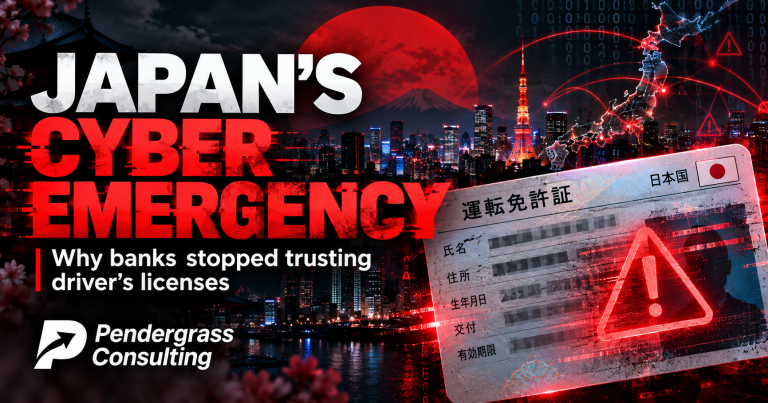
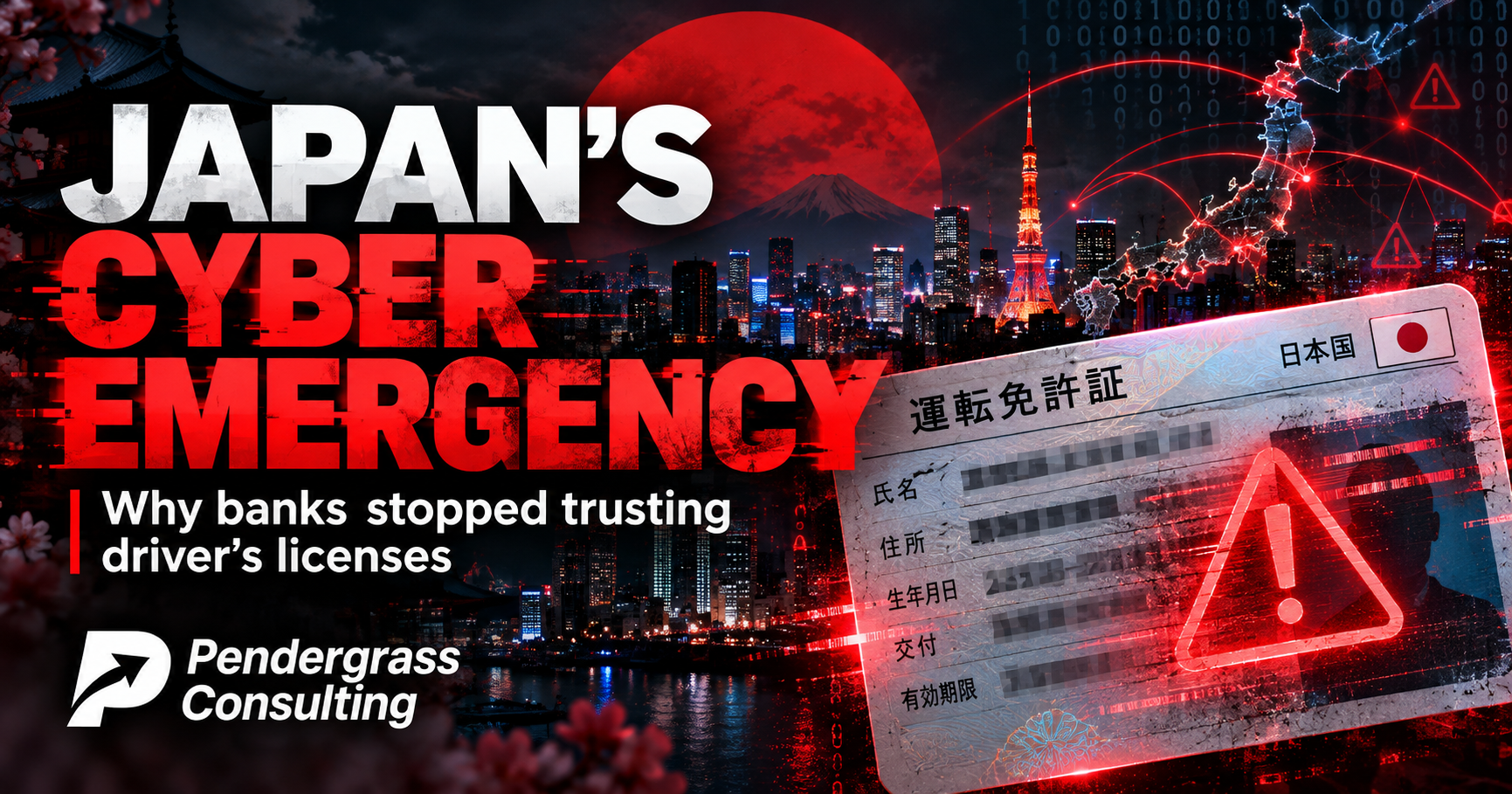
But the most important part of this story isn’t the phrase in the headline. It’s a much quieter decision that came out of it. Japan’s financial regulator told banks to stop accepting driver’s licenses as proof of identity when opening accounts, and to rely on chip-based ID instead.
Think about what it takes for a country to stop trusting its own driver’s licenses. That’s where this wave of breaches has pushed things — and the reason why is a lesson every business that checks identity should understand.
What was actually declared
A precise reading matters here, because the viral version overstates it a little. According to the Financial Times, the phrase “a state of emergency in cyberspace” came from Masaaki Taira, a ruling-party lawmaker who leads its cybersecurity strategy efforts, following an emergency meeting. Japan’s cybersecurity minister described the situation as “extremely critical.” Based on the reporting, this was a statement of how seriously officials view the situation, accompanied by concrete instructions — not a formal legal emergency order of the kind used for natural disasters.
That doesn’t make it less serious. It just means the useful parts of the story are the actions that followed:
- Japan’s national cybersecurity office sent instructions to government ministries, local governments, and companies to tighten their security.
- Japan’s financial regulator told banks to accept only identification with an embedded chip — passports and the national My Number card — rather than driver’s licenses.
This is the third time in a few weeks we’ve had to separate an accurate story from the headline wrapped around it. It’s becoming a pattern worth naming: the most-shared version of a security story is rarely the most useful one.
The wave
The companies that have disclosed attacks read like a list of the brands Japanese consumers use every day. Among those reported:
- Times Car, a car-sharing service, where an attack last month exposed data from about 6.6 million member accounts — including images of driver’s licenses, according to the Associated Press.
- JR East, the rail operator, which lost 1.67 million customer email addresses, according to the Financial Times.
- A SoftBank cloud unit, along with the convenience store chain Lawson, Daiwa Securities, and the secondhand retailer Bookoff, which have reported customer data leaks.
Reporting also describes restaurants, hospitals, and government agencies among those affected. Notice what kinds of organizations these are. Not defense contractors or intelligence agencies — a car-sharing app, a train line, a convenience store, a used bookstore. Ordinary businesses with ordinary customers. That’s the profile of a wave: attackers working through whatever is reachable, not picking targets one by one.
Why a country stopped trusting driver’s licenses
Here’s the connection that makes the bank rule make sense. When the car-sharing breach exposed images of millions of driver’s licenses, every one of those images became something a criminal could use to impersonate a real person — to open an account, pass a verification check, or convince a clerk. A driver’s license works as proof of identity only as long as possession of it, or a picture of it, is rare. Once millions of images are circulating, possession proves very little.
So the regulator did the logical thing: it moved to a form of ID that’s harder to fake from a photo. Chip-based documents can be checked electronically in ways a picture can’t.
We made this point last month, and now a national government has acted on it. When we covered the exposure of a reported 153 million driver’s license scans in the U.S., we said a leaked license is worse than a leaked password, because you can’t change your face, your birth date, or your license number. Japan’s response is the logical endpoint of that idea: when identity documents leak at scale, the documents themselves stop being trustworthy proof of identity. Every verification process built on “show me your license” gets a little weaker each time another batch leaks.
For a small business, this lands closer to home than it sounds. How do you verify that someone is who they say they are? If the answer is “they sent a photo of their license,” or “they knew their date of birth and address,” that check is weaker today than it was a year ago — because those details are increasingly sitting in breach data. We saw criminals talk a major bank out of customer files by impersonating an authority from a real, stolen email account. Knowing someone’s details, or holding a picture of their document, no longer proves you’re them.
Breaches stack — at national scale
A few weeks ago, writing about the FBI breach claim, we described how breaches stack on top of each other: an email address from one leak, a birth date from another, a license image from a third, and the profile assembles itself. Japan is what that looks like across a whole economy. Twenty-plus companies in a few weeks means the same people appear in several breaches at once — a rail email here, a convenience-store loyalty account there, a car-sharing license image somewhere else. Each one is limited on its own. Together, they’re a kit for impersonation.
Where AI fits — and where it doesn’t, yet
Officials and experts quoted in the coverage say AI is helping attackers scale phishing and scan for vulnerabilities faster than before. That’s consistent with what we’ve been tracking all year — including researchers who chained ordinary flaws into a major company’s source code in under 72 hours with AI’s help. At the same time, reporting notes that no direct link between AI and this particular wave has been established. So the fair statement is: AI is lowering the cost of attacks generally, and that makes waves like this easier to sustain, but nobody has shown it caused this one.
What the government told everyone to do
Here’s the part we find genuinely reassuring. Even at the level of a national alarm, the guidance to organizations was the basics: tighten security, keep systems updated, strengthen access controls, watch for phishing. Some commentators have criticized that guidance as too elementary for the scale of the problem. We’d read it the other way. When a country’s security establishment looks at a wave like this and concludes that the most urgent thing is the fundamentals, it’s telling you that the fundamentals are where most of these breaches start.
That’s the same conclusion we keep reaching from completely different stories. Attackers rarely need anything exotic. They need a password that works, a system nobody updated, a person who believed a convincing message. Waves are built out of ordinary openings, repeated.
Why a wave in Japan matters in North Carolina
Waves travel. The techniques that work against convenience stores and car-sharing apps in one country are the same techniques that get tried against restaurants, retailers, and service businesses everywhere else. We wrote recently that attackers don’t want better attacks, they want repeatable ones — and a successful wave is a playbook that’s been proven to work. The question isn’t whether these methods reach small businesses here. It’s whether your business is one of the ones they work on.
What to do
- Rethink how you verify identity. If you rely on a photo of a license, or on someone knowing personal details, add a step that a stolen document can’t satisfy — a call back to a number already on file, a code sent to a contact you’ve previously verified, or an in-person check for high-risk changes.
- Train your team for impersonation. As more personal data circulates, scammers sound more convincing. Your staff should know that a caller who knows a customer’s details hasn’t proven anything.
- Do the basics, deliberately. Multi-factor authentication on everything that matters, prompt updates, and a quick review of who has access to what. It’s what a national government told its own ministries to do.
- Collect and keep less identity data. If you don’t need to store copies of customers’ IDs, don’t. Data you don’t hold can’t add to the pile.
- Freeze your credit, and encourage your employees to. As breaches stack, this is the cheapest protection against someone opening accounts in your name.
Worth asking about your own business: When a customer asks to change their account details, payment information, or delivery address, how do you confirm it’s really them? * Would a stolen photo of their ID, or knowledge of their birth date, get past your process? * Does your team know that a caller who has someone’s details hasn’t proven who they are? * And are you storing copies of customer IDs you don’t actually need?
The takeaway
Japan’s “state of emergency in cyberspace” is a serious warning built on a real wave of breaches across ordinary businesses. But the detail that should stay with you is the bank rule. When enough identity documents leak, the documents stop proving identity — and every business that relies on them inherits the problem. The defense isn’t exotic. It’s verifying people in ways a stolen record can’t fake, training your team to expect convincing impostors, and doing the fundamentals that a national government just told everyone to do.
That’s what our focused security training is built for: teaching your team how impersonation actually sounds now that so much personal information is in circulation, and building verification habits that hold up when the person on the other end knows all the right details. A country just decided its driver’s licenses aren’t enough. It’s worth deciding what’s enough for your business, before someone tests it.
Sources: Financial Times (as reported by The Next Web); Associated Press; Mezha; Korben; and additional coverage, October 2026. The “state of emergency in cyberspace” characterization is attributed to Masaaki Taira as reported by the Financial Times; based on available reporting, it reflects officials’ assessment rather than a formal legal emergency order. Company figures are as reported by the cited outlets. No direct link between artificial intelligence and this wave of attacks has been established, and no single actor has been publicly identified as responsible.